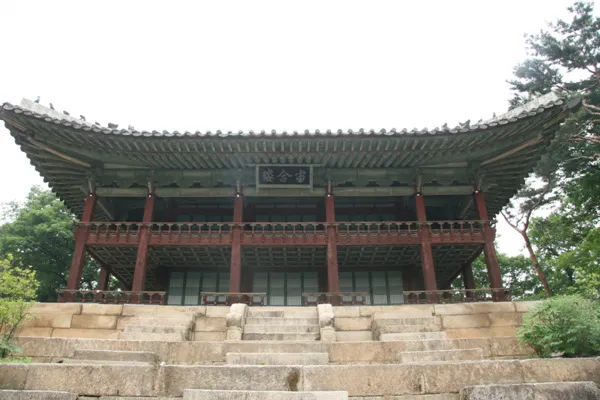
Changdeokgung Juhap Pavilion
昌德宮 宙合樓
서울특별시 종로구
Basic information
- Designation
- Treasure No.1769
- Category
- Architecture
- Era
- 조선시대
- Designated year
- 2012
- Location
- 종로구, 서울특별시— 서울특별시 종로구 율곡로 99-0 (와룡동, 창덕궁)
- Coordinates
- 37.581925, 126.992737
AI Docent
Coming soonAn AI-generated, friendly retelling of this heritage site is available in Korean. An English version is on our roadmap — for now, please see the official description below.
Description
Juhamnu Pavilion is one of the three palace pavilions built around Buyongji Pond in the rear garden of Changdeokgung Palace, the other two being Buyongjeong and Yeonghwadang. Around the pavilion is a three-tier flower garden through which Eosumun Gate leads to the pavilion. The name ‘Eosumun’ (meaning ‘Fish-Water Gate’) of the main entrance to Juhamnu refers to the harmonious relationship between the king (i.e. water) and his ministers (i.e. fish). The king used the main entrance whenever he visited Juhamnu, while his ministers were obliged to use the smaller archways at the side. Juhamnu Pavilion in Changdeokgung Palace is a two-story building built in the palace’s rear garden as a storage facility for the writings produced by the king. The base is a four-tier structure made by piling up rectangular stones in regular courses and covering them with stones. The main building features a two-story structure measuring five kan (a unit of measurement referring to the distance between two columns) at the front and four kan at the sides, single-block columns, and narrow verandas on all four sides. The building is also marked by the use of double-winged brackets combined with other elements that designed to ornament the space between the column heads and the eaves while supporting the roof structures, double-layer eaves, and hipped-and-gabled roof. The ridge and rakes are finished with lime plaster, and there are ornamental “eagle heads” on the ridge, “dragon heads” on the rakes, and “miscellaneous figurines” on the hip ridges. The pavilion is generally regarded as the main stage of King Jeongjo’s political reforms and the cultural renaissance of Joseon, and as the place where his distinguished scholar-statesmen, including Jeong Yak-yong, Park Je-ga, Yu Deuk-gong, and Yi Deok-mu, worked together to develop state policies and where the king’s own writings, paintings, calligraphic works and seals were stored. The building, which maintains its original condition, is located on the upper part of a slope in harmony with the surroundings, and has a verandah, four-panel folding doors, and a traditional floor-heating system. The lower story is perfectly designed to serve its function as a royal library, the upper story for observation of the natural beauty surrounding it.
Location
지도를 불러오는 중…
Have you visited this place?
Log in and verify your visit on-site via GPS to record a stamp in My Journey. (QR verification coming later.)
Images: KOGL (khs.go.kr) · Data source: Korea Heritage Service Open API (khs.go.kr)