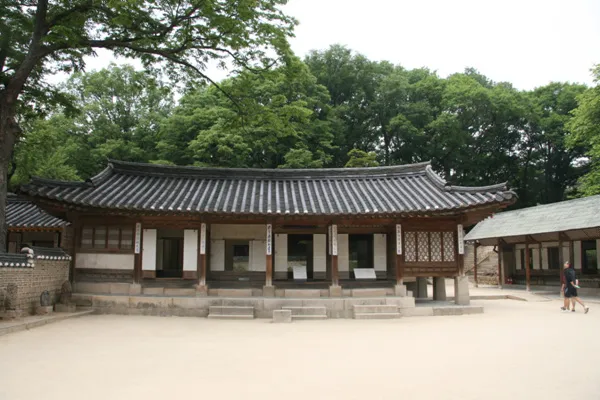
Changdeokgung Yeongyeong Hall
昌德宮 演慶堂
서울특별시 종로구
Basic information
- Designation
- Treasure No.1770
- Category
- Architecture
- Era
- 조선시대
- Designated year
- 2012
- Location
- 종로구, 서울특별시— 서울특별시 종로구 율곡로 99-0 (와룡동, 창덕궁)
- Coordinates
- 37.583179, 126.992332
AI Docent
Coming soonAn AI-generated, friendly retelling of this heritage site is available in Korean. An English version is on our roadmap — for now, please see the official description below.
Description
Yeongyeongdang Hall stands beyond the area in which Juhamnu Pavilion and Yeonghwadang Hall are located, in the beautiful rear garden of Changdeokgung Palace. It is surrounded by hills on three sides, but is open to the east, where Aeryeonji Pond is located. After passing the main gate, called Jangnangmun, there is a wall with two tall gates. Jangyangmun Gate to the east and Suinmun Gate to the west are connected to the courtyards of the sarangchae (men’s quarters) and the anchae (women’s quarters), respectively. The men’s and women’s quarters are separated by a wall standing at the center of the courtyard, while Jeongchumun Gate, built into the middle of this wall, serves as a passage between the quarters. Originally, the men’s living quarters were called Yeongyeongdang, but the name came to refer to the entire complex and its buildings. A study, Seonhyangjae, is located to the right of the men’s quarters, while stone stairs decorated with flower trees are constructed behind Seonhyangjae, along with a pavilion called Nongsujeong at the top. According to several ancient documents of Korea, Yeongyeongdang was built in 1828 (the 28th year of the reign of King Sunjo of the Joseon Dynasty). Constructed in accordance with Confucian principles and the typical architectural style of aristocratic residences, the layout and structure of the buildings in this complex provide a wealth of significant information for studies of the history of Korean residential architecture. Moreover, as the buildings were constructed using the superior techniques and skills that were used to build the royal palaces, they exhibit a sophisticated elegant appearance in terms of their structure and detailed decoration.
Location
지도를 불러오는 중…
Have you visited this place?
Log in and verify your visit on-site via GPS to record a stamp in My Journey. (QR verification coming later.)
Images: KOGL (khs.go.kr) · Data source: Korea Heritage Service Open API (khs.go.kr)