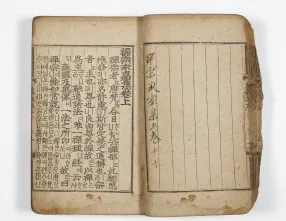
Seonjongyeonggajip(eonhae)(2010)
禪宗永嘉集(諺解)(2010)
경상남도 산청군
Basic information
- Designation
- Treasure No.774-2
- Category
- Books & Records
- Era
- 1464년
- Designated year
- 2010
- Location
- 산청군, 경상남도— 경남 산청군 단성면 묵곡리 210번지 겁외사
- Coordinates
- 35.279924, 127.967898Kakao address conversion
AI Docent
Coming soonAn AI-generated, friendly retelling of this heritage site is available in Korean. An English version is on our roadmap — for now, please see the official description below.
Description
This xylographic book of two volumes, Seonjong yeonggajip (Essence of Zen Buddhism), contains ten essays written by a great Tang monk Yongjia Xuanjue (647-713) on the Seon (Zen or Chan) Buddhism which were later edited by a Tang official Wei Jing (fl. 8th c.) and annotated by two Song monks, Hangjing and Jingyuan (1011–1088). The Chinese text was then added with Korean suffixes by King Sejo (r. 1455-1468) and translated into Korean by a Joseon monk Sinmi (fl. 15th c.) and Prince Hyoryeong (1396-1486) before being published in 1464 by a special government agency called Directorate of Sutra Publication (Gangyeongdogam). The book contains a preface on the front page of the first volume written by Hwang Su-sin (1407-1467) who supervised the publication project by leading a team of twenty officials who are duly acknowledged in it. It was followed by an introduction written by Wei Jing and the main text divided into ten chapters, five chapters in each volume, focused on the detailed practice of Seon Buddhism. The Chinese text is attached with Korean translations, affixes and diacritics used to mark pitch accents in Hangul for Middle Korean according to the principles set in The Standard Rhymes of the Eastern State (Donggukjeongun, 1448). The book has lost all of its four covers but preserved entire text of the first volume and most (77 leaves) of the second volume. The text is printed on the paper made by mixing mulberry and oat, and there is on the title page of the second volume a stamped seal showing that the text was duly proofread and edited. The book is regarded very valuable because it is one of the rarest first edition books using newly-invented Korean alphabets and published at the government agency of Gangyeongdogam. Currently kept in Geoboesa Temple, Sancheong, the book is in better condition, and hence regarded more valuable, than the other two books of the same title which are designated as Treasures, Nos. 774 and 1163, and collected by Dongguk University Museum and the National Palace Museum of Korea respectively. The book contains a wealth of information about Korean Buddhism and Buddhist publications of early Joseon and the Korean language just after the promulgation of the Korean writing system in 1446.
Location
지도를 불러오는 중…
Have you visited this place?
Log in and verify your visit on-site via GPS to record a stamp in My Journey. (QR verification coming later.)
Images: KOGL (khs.go.kr) · Data source: Korea Heritage Service Open API (khs.go.kr)