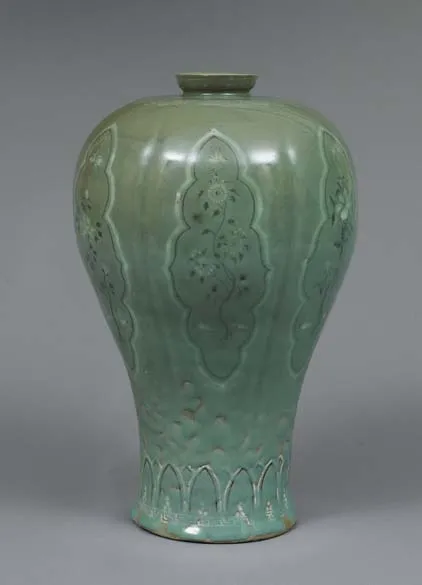
Celadon Sanggamgukhwamoranyurojukmun Maebyeong Mit Jukchal
靑磁 象嵌菊花牡丹柳蘆竹文 梅甁 및 竹札
충청남도 태안군
Basic information
- Designation
- Treasure No.1783
- Category
- Craft
- Era
- (12세기 말 ~ 13세기 초)
- Designated year
- 2012
- Location
- 태안군, 충청남도— 충청남도 태안군 신진대교길 101 (근흥면, 국립해양문화재연구소 서해수중유물보관동)
- Coordinates
- 34.768600, 126.375300Museum-based location
AI Docent
Coming soonAn AI-generated, friendly retelling of this heritage site is available in Korean. An English version is on our roadmap — for now, please see the official description below.
Description
This celadon vase with a bamboo strip was discovered in the remains of a Goryeo boat referred to as Mado Boat 2 because it was excavated at an underwater site around Mado Island of Geunheung-myeon, Taean-gun, Chungcheongnam-do. Both relics are assumed to have been made some time between the late 12th and early 13th century. The vase features a body divided into six sections by incised lines like the shape of a melon. There are supplementary motifs of fret and lotus band on the upper and lower parts, while the central design features several different motifs made by combining willow and bird, bamboo, reed and bird, and peony or chrysanthemum with bird and moth, all of which are set within a “water chestnut window”. The melon-shaped body and the multiple motif design are typical of the changes made to Goryeo celadon works after the 13th century. The surface contains areas of uneven glazing dotted with pinholes and signs of clogging. The melon-shaped body, mixed designs, various inlay techniques and different-colored glaze have led some experts to assume that this vase was made in a different period from the vase decorated with incised designs. Others, however, consider it as evidence that there was a great diversity of shapes and designs among Goryeo celadon wares produced around the 13th century. The vase was discovered with a bamboo slip that contains the name of the vase, Jun (樽), and information that the vase was used to contain sesame oil.
Location
지도를 불러오는 중…
Have you visited this place?
Log in and verify your visit on-site via GPS to record a stamp in My Journey. (QR verification coming later.)
Images: KOGL (khs.go.kr) · Data source: Korea Heritage Service Open API (khs.go.kr)