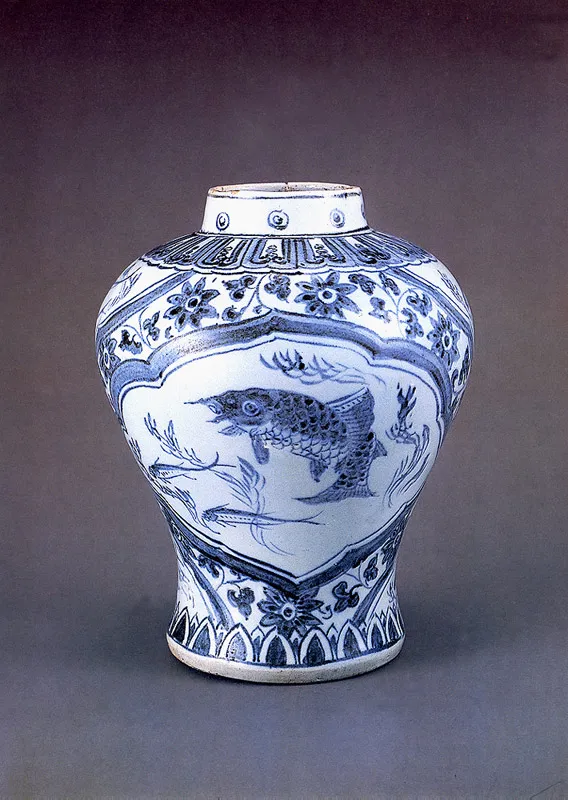
White Porcelain Cheonghwaingeomun Jar
白磁 靑畵鯉魚文 立壺
서울특별시 용산구
Basic information
- Designation
- Treasure No.788
- Category
- Craft
- Era
- 조선시대
- Designated year
- 1984
- Location
- 용산구, 서울특별시— 서울특별시 용산구 이태원로55길 60-16 (한남동, 삼성미술관 리움)
- Coordinates
- 37.536528, 126.996187
AI Docent
Coming soonAn AI-generated, friendly retelling of this heritage site is available in Korean. An English version is on our roadmap — for now, please see the official description below.
Description
White porcelain in underglaze cobalt blue was first developed during the first half of the 14th century in the Yuan Dynasty of China. Blue painting on a surface of white porcelain looks like a watercolor painting. This type of porcelain was first made in Korea in the middle of 15th century, and the Korean porcelains showed more realistic paintings. The piece shown here is 24.7 cm tall while the diameter is 8.1 cm at the mouth and 12.4 cm at the base. The mouth is bent inwards and, therefore, is not so wide. The shoulder starts out in a bulging shape, narrowing as it reaches the lower body and widening again at the heel. This is an elegant jar displaying the typical features of those made during the early Joseon Dynasty. On the body is a large frame surrounded by flower designs, just like a window decorated with flowers. Inside the frame is a painting of fish, which look real and alive. The painting, which shows carp and minnows swimming among waterweeds as well one of lotus vines filling up the outside of the flower frame, is of the same composition as paintings found on the blue-and-white porcelains from the Ming Dynasty of China. The enamel used has a gray white color with a blue tone. The wall of the jar is rather thick. The picturesque beauty of the painting is further enhanced by the adroit control over the concentration of azure blue color. Experts believe that this white porcelain piece was made at a government kiln in Gwangju, Gyeonggi-do. It is an excellent example of work from the early Joseon Dynasty.
Location
지도를 불러오는 중…
Have you visited this place?
Log in and verify your visit on-site via GPS to record a stamp in My Journey. (QR verification coming later.)
Images: KOGL (khs.go.kr) · Data source: Korea Heritage Service Open API (khs.go.kr)