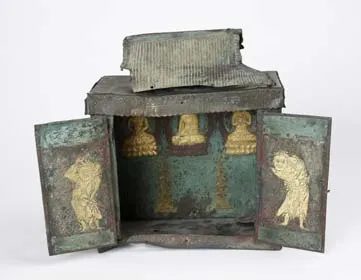
Sujongsa Palgagocheungseoktap Chultoyumul (Collection), Namyangju
南楊州 水鍾寺 八角五層石塔 出土遺物 一括
서울특별시 종로구
Basic information
- Designation
- Treasure No.1788
- Category
- Sculpture
- Era
- 조선전기(15세기), 1628년(인조6)
- Designated year
- 2012
- Location
- 종로구, 서울특별시— 서울특별시 종로구 견지동 45-0 불교중앙박물관
- Coordinates
- 37.573891, 126.982333Kakao address conversion
AI Docent
Coming soonAn AI-generated, friendly retelling of this heritage site is available in Korean. An English version is on our roadmap — for now, please see the official description below.
Description
The Artifacts Excavated from the Octagonal Five-story Stone Pagoda of Sujongsa Temple, Namyangju, are presumed to have been produced in the late 15th century and around 1628 (the 6th year of the reign of King Injo during the Joseon Dynasty). Though the portable shrine is seriously damaged, it nevertheless furthers understanding of the structure of portable shrines of the early Joseon Period. In addition, the figures and decorations of the shrine provide various items of information about Buddhist art of that period. For example, the two narrow and tall pagodas depicted on the portable shrine display the typical style of pagodas erected in the early Joseon Period, and the Buddhist painting on the back was prevalent in the same period. Furthermore, the Buddhas of the Three Bodies at the center of the portable shrine and the paintings of Avalokitesvara Bodhisattva and Ksitigarbha Bodhisattva on both sides of the portable shrine were also very popular subjects for statues and paintings in the same period. The letter of invocation excavated with the portable shrine reveals that all these artifacts were closely related to the royal family of the Joseon Dynasty. Notably, according to the inscription carved on the bottom of the pedestal of a gilt-bronze seated Vairocana Buddha, this statue was produced at the request of Queen Dowager Inmok, who was one of the consorts of King Seonjo, the fourteenth ruler of the Joseon Dynasty. The inscription also includes the name Seongin, who was a sculptor during the early 17th century, which is worthy of special attention as he is possibly the same person who made the Wooden Seated Vairocana Buddha at Jijangam Hermitage. These statues, which are presumed to date back to the 15th century, appear to have inherited the tradition of Buddhist statues made in the late Goryeo Period, while the statues dated to the 17th century are noteworthy in that they show the social status of Buddhism at that time. It is not known how the portable shrine and Buddhist statues were enshrined altogether in the Octagonal Five-story Stone Pagoda of Sujongsa Temple, but they are regarded as valuable assets as they represent the type of Buddhist art enjoyed by the royal family of the Joseon Dynasty.
Location
지도를 불러오는 중…
Have you visited this place?
Log in and verify your visit on-site via GPS to record a stamp in My Journey. (QR verification coming later.)
Images: KOGL (khs.go.kr) · Data source: Korea Heritage Service Open API (khs.go.kr)