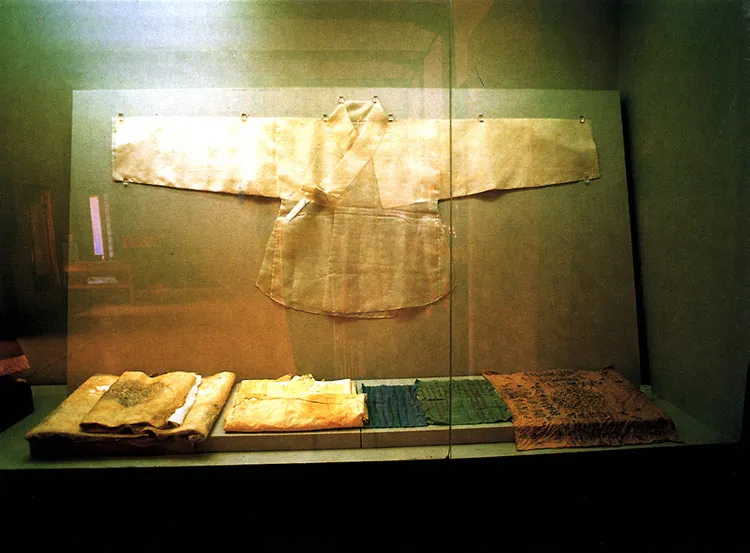
Sangwonsa Mokjomunsudongjajwasang Reliquary Objects, Pyeongchang
平昌 上院寺 木造文殊童子坐像 腹藏遺物
강원특별자치도 평창군
Basic information
- Designation
- Treasure No.793
- Category
- Craft
- Era
- 조선시대
- Designated year
- 1984
- Location
- 평창군, 강원특별자치도— 강원도 평창군 오대산로 176 (진부면, 월정사성보박물관)
- Coordinates
- 37.718831, 128.602948Kakao address conversion
AI Docent
Coming soonAn AI-generated, friendly retelling of this heritage site is available in Korean. An English version is on our roadmap — for now, please see the official description below.
Description
In a very rare case, several relics were found in a Wooden Seated Child Manjusri (Treasure No. 221) of Sangwonsa Temple located on Odaesan Mountain in Pyeongchang-gun, Gangwon-do. Two records on the origin of a Buddha statue and details about its manufacture, and 23 relics of the early Joseon Dynasty were found in July, 1984. The first of the two records says that Princess Uisuk, the second daughter of King Sejo, and her husband Jeong Hyeon-jo placed Bodhisattva and Buddha statues in Munsusa Temple on Odaesan Mountain in the 12th year of King Sejo’s reign (1466) for the well-being of King Sejo and the royal family. This record measures 31.5 cm in length and 24 cm in width, written in red on blue silk. The other record says two manjusri, young monk statues, and 16 other Buddhist statues were repainted in 1599. This also was written in red on blue silk measuring 34.6 cm in length and 29.1 cm in width. 13 books including Baekjimukseojejineon, Daebanggwangbul hwaeomgyeong (Avatamsaka Sutra), Odaejineon (Five Dharani Sutras), five Myobeob yeonhwagyeong (Saddharmapundarika Sutras), two Wongakgyeong and three Yukgyeong hapbu (Six Sutras) were found. Baekjimukseojejineon, a transcription of Buddhist sermons, is rolled up as a scroll and measures 41.8 cm in length and 679.3 cm in width. Daebanggwangbul hwaeomgyeong (Avatamsaka Sutra) is the 28th out of 60 books and presumed to have been published in the 12th or 13th century. Measuring 31.6 cm in length and 12 cm in width, this is a collapsible piece like a folding screen. Odaejineon (Five Dharani Sutras) were written in Sanskrit, Korean and Chinese order. The original Buddhist scripture from the Tang Dynasty in China was translated into Korean and published in the 16th year of King Seongjong’s reign (1485) by order of Insudaebi, mother of King Seongjong. It is a woodcut edition, measuring 27 cm in length by 16 cm in width. Saddharmapundarika Sutra, combining the 1st to 3rd parts and the 4th to 7th parts of Myobeob yeonhwagyeong, measures 26.9 cm by 16.8 cm. It was engraved by Monk Haerin over the course of one year, and published in the first year of the reign of King Jeongjong (1339) of the Goryeo Dynasty. Parts 1 to 7 of Myobeob yeonhwagyeong measure 24.1 cm in length and 8.5 cm in width and are collapsible like a folding screen. It was published as a woodcut edition in the 4th year of the reign of King Taejong (1404) of the Joseon Dynasty. Parts 6 to 7 measure 35 cm in length and 25 cm in width. Parts 1 to 3 measure 27.6 cm in length and 16.6 cm in width as a woodcut edition. Yukgyeonghapbu (Six Sutras) measures 29.3 cm in length and 17.3 cm in width. It was carved in 1440 and printed in the 3rd year of the reign of King Seongjong (1472) by order of Insudaebi, Queen Mother of King Seongjong. Later, it was carved again in Hwaamsa Temple in the 19th year of King Seongjong’s reign (1448) and measures 26.6 cm in length and 15.7 cm in width. It is well preserved. Another Yukgyeonghapbu, which is presumed to have been published between the time of King Sejo and King Myeongjong, measures 26.4 cm in length and 16.3 cm in width. It is in poor state of preservation. There are two Korean-style silk unlined summer jackets made for upper class people. There are also a yellow wrapping cloth, three glass beads, and a sarira. Of the relics, two records contribute valuable source indicating when the various Buddhist statues and Bodhisattvas were made, and Baekjimukseojejineon, the transcription of sermons, is a rare example of a printed book from early Joseon. Other printed books also have their own bibliographical characters.
Location
지도를 불러오는 중…
Have you visited this place?
Log in and verify your visit on-site via GPS to record a stamp in My Journey. (QR verification coming later.)
Images: KOGL (khs.go.kr) · Data source: Korea Heritage Service Open API (khs.go.kr)