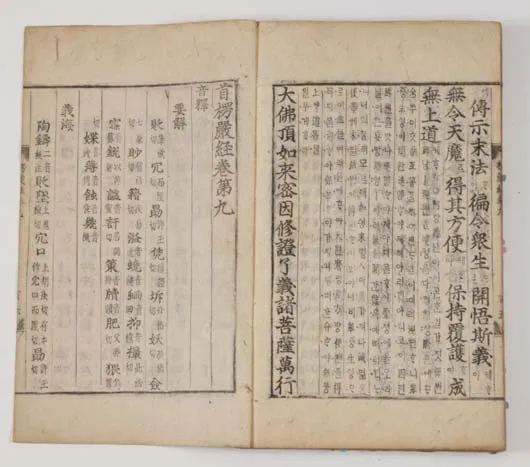
Daebuljeongyeoraemirinsujeungyouijebosalmanhaengsuneungeomgyeong(eonhae) Gwon9
大佛頂如來密因修證了義諸菩薩萬行首楞嚴經(諺解) 卷九
경기도 고양시
Basic information
- Designation
- Treasure No.1794
- Category
- Books & Records
- Era
- 조선 전기
- Designated year
- 2012
- Location
- 고양시, 경기도— 경기도 고양시 일산동구 동국로 137-48 (식사동)
- Coordinates
- 37.685981, 126.805096Kakao address conversion
AI Docent
Coming soonAn AI-generated, friendly retelling of this heritage site is available in Korean. An English version is on our roadmap — for now, please see the official description below.
Description
The Shurangama Sutra (The Sutra of the Heroic One) was first translated into Chinese during the Tang Period by an eminent Indian Buddhist named Paramiti and annotated by a Song scholar-monk named Jiehuan in the 12th century. Its translation into Korean was begun in 1449 (the 31st year of the reign of King Sejong of the Joseon Dynasty) by Prince Suyang at the behest of King Sejong (r. 1418-1450), but was only completed in 1461 (the 7th year of King Sejo’s reign) by a group of scholars including Sinmi (a.k.a. Hyegak Jonja), Han Gye-hui, and Kim Su-on, who also added the annotations. The first edition of the sutra in Chinese characters was printed in 1455 (the 1st year of King Sejo’s reign) by using Eulhae Types of three different sizes (small, medium, and large) made on the basis of the handwriting of Kang Hui-an, whereas the Korean translation was printed in 1462 with Hangeul types cast specially for the publication of the Korean edition. This book, currently held in Wongaksa Temple, was printed using Eulhae Types cast in the mid-15th century and contains directions for revisions written in red ink, revealing that it is part of a revised edition. Its front cover and some of the characters on the first page have been lost, but the rest is comparatively well preserved. This item - combined with the same fascicle of the Shurangama Sutra collected by the King Sejong Memorial Society, which has been designated as Treasure No. 763 despite the loss of pages 1 to 26 and the back cover, has helped scholars to restore the entire Volume 9 of the Shurangama Sutra printed with the Eulhae Types, making it a valuable resource for study of Korean language and bibliography in the early Joseon Period.
Location
지도를 불러오는 중…
Have you visited this place?
Log in and verify your visit on-site via GPS to record a stamp in My Journey. (QR verification coming later.)
Images: KOGL (khs.go.kr) · Data source: Korea Heritage Service Open API (khs.go.kr)