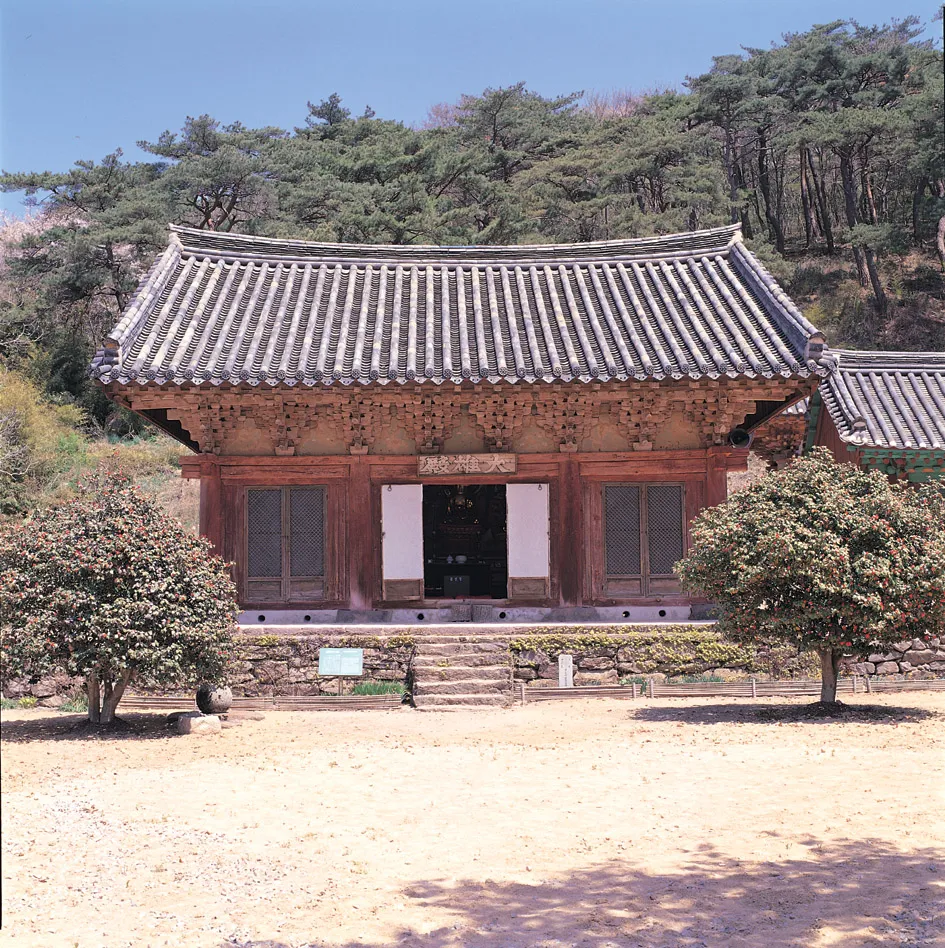
Seonunsa Chamdangam Daeungjeon Hall, Gochang
高敞 禪雲寺 懺堂庵 大雄殿
전북특별자치도 고창군
Basic information
- Designation
- Treasure No.803
- Category
- Architecture
- Era
- 조선 영조 22년(1746)
- Designated year
- 1984
- Location
- 고창군, 전북특별자치도— 전북 고창군 아산면 도솔길 194-77, 선운사 (삼인리)
- Coordinates
- 35.493047, 126.563790
AI Docent
Coming soonAn AI-generated, friendly retelling of this heritage site is available in Korean. An English version is on our roadmap — for now, please see the official description below.
Description
There are two views on the foundation of Seonunsa Temple. One is that it was built by King Jinheung of Silla and the other is that a Master Geomdan built it in the 24th year of the reign of King Wideok (577) of Baekje. It was burnt down during the second Japanese Invasion of Korea in 1597, the 30th year of the reign of King Seonjo of Joseon, and it was rebuilt and completed in 1619, the 11th year of the reign of Gwanghaegun. It has gone through several periods of rebuilding and renovation since that time. There were a number of hermitages originally in Seonunsa Temple, but nowadays, only Dongunam, Seoksangam, Chamdangam and Dosolam Hermitages remain. A Buddhist Monk Uimun built Daeungjeon Hall of Chamdangam Hermitage at the request of King Jinpyeong of Silla. The present building, built in the Joseon Dynasty, has come down to us even though it has been through several periods of repair. It is composed of 3-kan (a unit of measurement referring to the distance between two columns) front space and 3-kan side space and it has a gable roof called matbaejibung. The gongpo that supports the eaves of the roof is set up not only on the pillars but also between them. This building style is known as dapo style. The hall shows the typical dapo style of the 18th century on its front side, while at the rear side it adopts the jusimpo style, with the gongpo set only on the pillars. It is assumed that the materials from the Goryeo period were used when the hall was repaired, because the materials used for the gongpo are little known to us up to now. The hall is regarded as an important cultural asset and as a source for studying details of Goryeo Dynasty buildings.
Location
지도를 불러오는 중…
Have you visited this place?
Log in and verify your visit on-site via GPS to record a stamp in My Journey. (QR verification coming later.)
Images: KOGL (khs.go.kr) · Data source: Korea Heritage Service Open API (khs.go.kr)