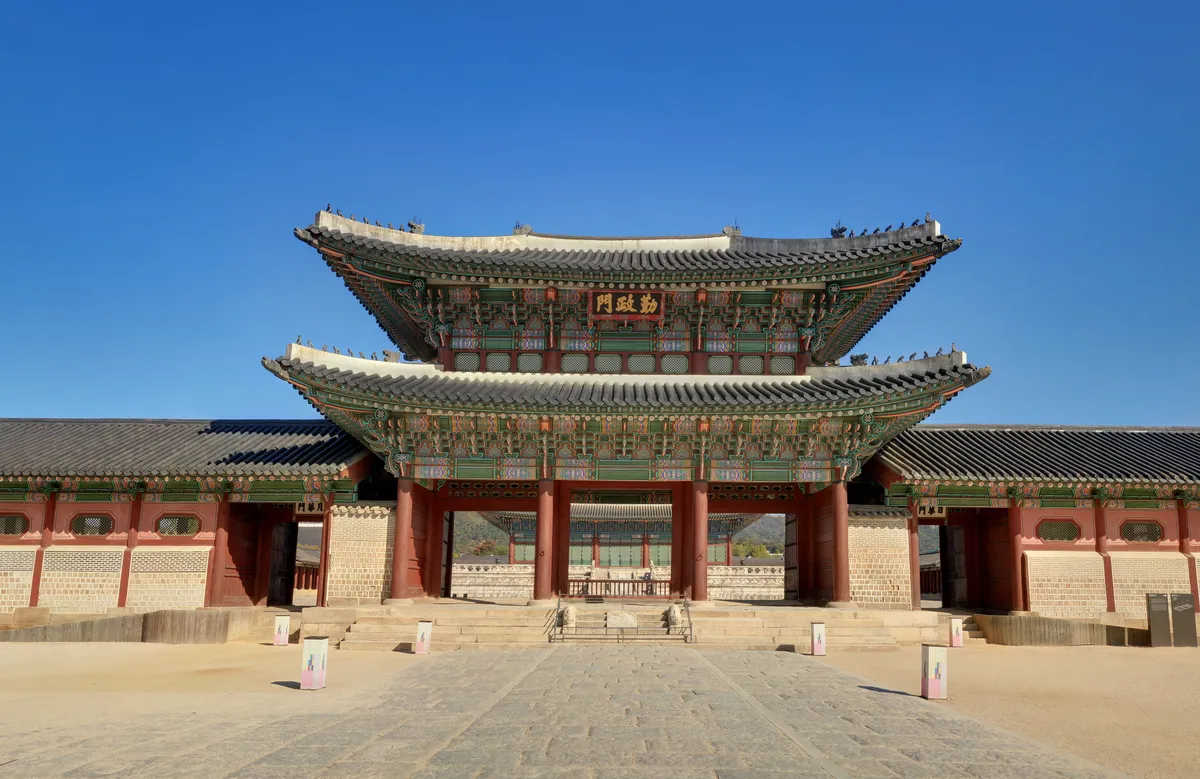
Gyeongbokgung Geunjeongmun Mit Haeng Pavilion
景福宮 勤政門 및 行閣
서울특별시 종로구
Basic information
- Designation
- Treasure No.812
- Category
- Architecture
- Era
- 조선시대
- Designated year
- 1985
- Location
- 종로구, 서울특별시— 서울특별시 종로구 사직로 161 (세종로, 경복궁)
- Coordinates
- 37.577595, 126.976910
AI Docent
Coming soonAn AI-generated, friendly retelling of this heritage site is available in Korean. An English version is on our roadmap — for now, please see the official description below.
Description
Geunjeongmun is the south gate of Geunjeongjeon, the main hall of Gyeongbokgung Palace. It is surrounded by corridors on both sides. It was built at the same time as the palace in 1395, the fourth year of King Taejo’s reign, but was burnt down in the Japanese Invasion of Korea in 1592. The present gate was built when Gyeongbokgung Palace was rebuilt in 1876, the fourth year of the reign of King Gojong. Geunjeongmun is a two-story building composed of 3-kan (a unit of measurement referring to the distance between two columns) front space and 2-kan side space. It has a hip roof called ujingakjibung, showing a trapezoid shape when looked at from the front. The gongpo that supports the roof eaves on the pillars is set up not only on the pillars but also between them. This building style is known as dapo style. It is the typical style of the latter part of Joseon that the shape of the materials extending to the outside is sharp and forms a big curve. Geunjeongjeon Hall is surrounded by Haenggak, a rectangular-shaped gallery with two corridors, which were originally one. Its style and structure are generally simple. There are the gates Ilhwamun and Wolhwamun where Namhaenggak (south Haenggak) meet, and Sajeongmun in the center of Bukhaenggak (north Haenggak). Two pavilions, Yungmunnu and Yungmuru, are placed to the east and west respectively. It has the unique features that the corners of the quadrilateral windows were made diagonally and that the style of the ceiling leaves all the materials exposed. This is the only two-story building remaining among the south gates of the main palace buildings of the Joseon Dynasty. It is an important cultural asset and a source for studying palace architecture.
Location
지도를 불러오는 중…
Have you visited this place?
Log in and verify your visit on-site via GPS to record a stamp in My Journey. (QR verification coming later.)
Images: KOGL (khs.go.kr) · Data source: Korea Heritage Service Open API (khs.go.kr)