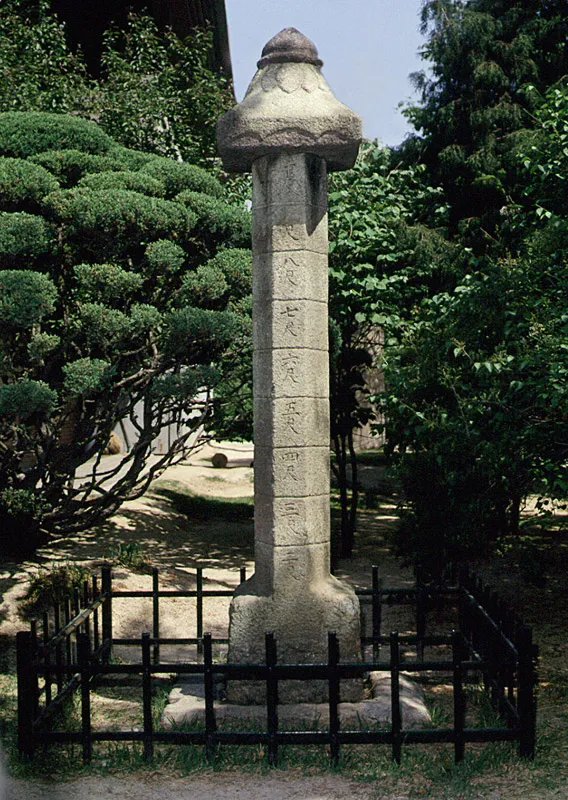
Cheonggyecheon Supyo, Seoul
서울 淸溪川 水標
서울특별시 동대문구
Basic information
- Designation
- Treasure No.838
- Category
- Craft
- Era
- 조선시대
- Designated year
- 1985
- Location
- 동대문구, 서울특별시— 서울 동대문구 회기로 56, 세종대왕기념관 (청량리동)
- Coordinates
- 37.590615, 127.043852
AI Docent
Coming soonAn AI-generated, friendly retelling of this heritage site is available in Korean. An English version is on our roadmap — for now, please see the official description below.
Description
After the invention of the cheugugi, a rain gauge which scientifically measured the amount of rainfall, during the reign of King Sejong the Great, supyo (water gauge) were installed to measure the water level of rivers. Supyo were installed in two places, the Hangang riverside and Cheonggyecheon, but the two devices were a little different from each other. The supyo of the Hangamg riverside has its gradations inscribed directly on the rock by the river, while the Cheonggyecheon one has a wood pillar set up on a low rock pillar. The water gauge at Cheonggyecheon Stream, which still remains, is a development of an earlier one, constructed during the reign of King Seongjong (1469-1494). It is a quadrilateral granite pillar 3m in height and 20 cm in width. There is a conical hat-shaped foundation stone inscribed with lotus flower patterns on top of it and a rectangular cornerstone deeply embedded in the ground. Gradations are carved on both sides of this pillar at every 1 cheok (21cm) from 1 cheok to 10 cheok. A zero mark is engraved at every 3, 6 and 9 cheok, called respectively galsu, pyeongsu and daesu. When the water rise up to 6 cheok or so, it is considered to be at normal level, if over 9 cheok, then it indicates an overflow of the river and is considered as a dangerous level. Compared with the wooden supyo of King Sejong's reign, it is unfortunate that it cannot deal with measurements such as chon (3.03030cm) and pun (a tenth of chon). However, it is a much improved version of supyo, able to predict drought and flood as well as having a graceful appearance. It is now preserved in the Memorial Hall of King Sejong the Great.
Location
지도를 불러오는 중…
Have you visited this place?
Log in and verify your visit on-site via GPS to record a stamp in My Journey. (QR verification coming later.)
Images: KOGL (khs.go.kr) · Data source: Korea Heritage Service Open API (khs.go.kr)