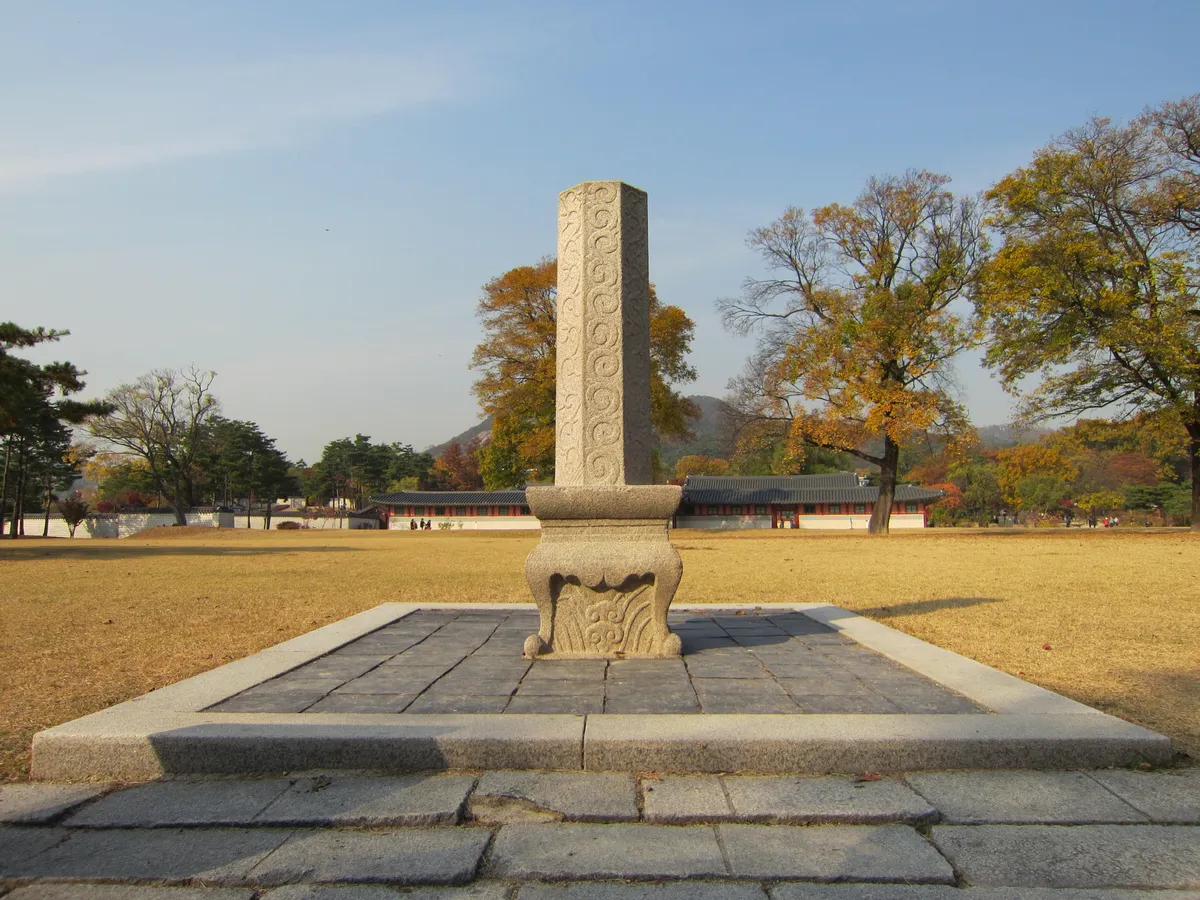
Gyeongbokgung Punggidae
景福宮 風旗臺
서울특별시 종로구
Basic information
- Designation
- Treasure No.847
- Category
- Craft
- Era
- 조선시대
- Designated year
- 1985
- Location
- 종로구, 서울특별시— 서울특별시 종로구 사직로 161 (세종로, 경복궁)
- Coordinates
- 37.580622, 126.976952
AI Docent
Coming soonAn AI-generated, friendly retelling of this heritage site is available in Korean. An English version is on our roadmap — for now, please see the official description below.
Description
From Jeungbomunheonbigo (Revised Analysis of Literary Sources) on the wind streamer and its pedestal used during the Joseon Dynasty for measuring the strength and direction of the wind, one can get to know the following facts. The granite structure is seated on an octagonal pillar engraved with pictures of clouds, and beneath it there is a pedestal on which images are also engraved. At the center of the top, there is a hole for inserting a flagpole and below it, on the side of the pillar; a drainage hole has been made so that the hole does not get filled up with water. The length of the pole is not certain, but at the end of the pole there was tied a long, narrow flag, and the direction and the strength of the wind could be known from the degree of the flutter. With the observation technology that had developed since the time of King Sejong the Great, amounts of rainfall and the levels of river and stream water were measured with a pluviometer. However, it has not been discovered from when winds were measured with the wind streamer. But it can be known that it was used at least from the 18th century, and this wind streamer pedestal, too, looks as if it dates from that time. Donggwoldo, a painting of a royal palace from the time, shows a wind streamer that flutters at length, from which one may make a guess about the time of its appearance. The height of the bottom pedestal is 80.0 cm, and of the 8-cornered pillar, 143.5 cm, making the total height 224.3 cm. It occupies an epoch-making position in the meteorological observatory of the Joseon Dynasty as actual evidence of measuring the winds, along with the wind streamer pedestal of Changgyeonggung Palace.
Location
지도를 불러오는 중…
Have you visited this place?
Log in and verify your visit on-site via GPS to record a stamp in My Journey. (QR verification coming later.)
Images: KOGL (khs.go.kr) · Data source: Korea Heritage Service Open API (khs.go.kr)