Hyudaeyong Angbuilgu
携帶用 仰釜日晷
서울특별시 용산구
Basic information
- Designation
- Treasure No.852
- Category
- Craft
- Era
- 조선 고종 8년(1871)
- Designated year
- 1986
- Location
- 용산구, 서울특별시— 서울특별시 용산구 서빙고로 137 (용산동6가, 국립중앙박물관)
- Coordinates
- 37.524041, 126.980350
AI Docent
Coming soonAn AI-generated, friendly retelling of this heritage site is available in Korean. An English version is on our roadmap — for now, please see the official description below.
Description
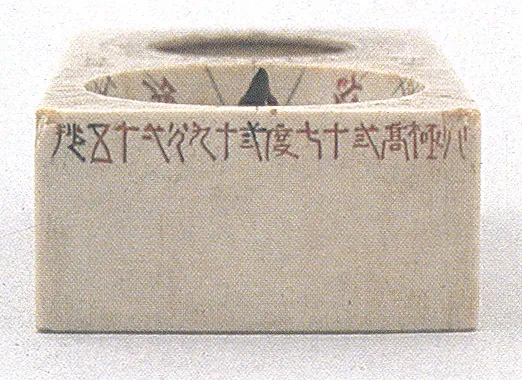
This was the most precise among the sundials made during the Joseon Period but was the smallest; it was carried on the body and used for measuring time. Made of a 5.6 cm × 3.3 cm × 1.6 cm stone, it showed that it had Seoul’s latitude as the standard. The name of the manufacturer and the year of manufacture (1871) are engraved on it, making it academically valuable as a sundial. The surface of this hemispherical sundial has diameter of 2.8 cm; the diameter of the compass is 1.9 cm. There are 24 directional words engraved on the surroundings of the compass. Engraved on one half of the sundial are daytime and visual angle line. There are also 24 solar terms and solar term lines -- from the winter solstice to the summer solstice -- engraved on it. These portable sundials are very rare relics made with extraordinary manufacturing skills and are precious materials showing the precision and excellence of the scientific machinery manufacturing technologies of the Joseon Dynasty. Hemispherical sundials were first invented during the reign of King Sejong (r. 1418-1450) and were produced continuously until the end of the Joseon Dynasty. They were widely used at royal palaces, government offices, and sometimes at the homes of upper classes of society. The sundials can be classified into one that measures time after installing in a garden and portable one. Those installed in a garden were usually made of bronze or stones as well as porcelain and were mostly placed on top of a stone prop. The portable ones come in two types: the one simply with the surface carved to be sunken in and a needle propped up at the center, and; the precise one, which has a magnet attached to it, accurately displaying south and north.
Location
지도를 불러오는 중…
Have you visited this place?
Log in and verify your visit on-site via GPS to record a stamp in My Journey. (QR verification coming later.)
Images: KOGL (khs.go.kr) · Data source: Korea Heritage Service Open API (khs.go.kr)