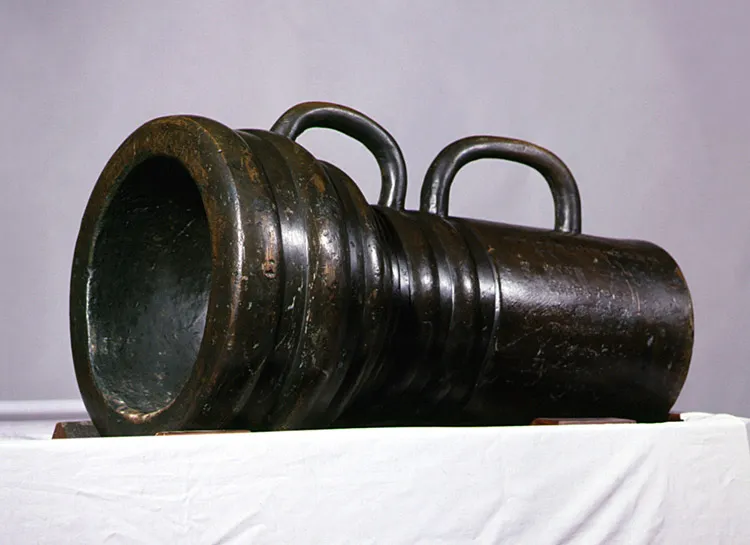
Daewangu
大碗口
경상남도 진주시
Basic information
- Designation
- Treasure No.857
- Category
- Craft
- Era
- 조선시대
- Designated year
- 1986
- Location
- 진주시, 경상남도— 경상남도 진주시 남강로 626-35 (남성동, 국립진주박물관)
- Coordinates
- 35.185100, 128.086000Museum-based location
AI Docent
Coming soonAn AI-generated, friendly retelling of this heritage site is available in Korean. An English version is on our roadmap — for now, please see the official description below.
Description
Called wangu or daenggu in Korean, this mortar is a type of firearm that can be shot by ignition on a wire. Choe Hae-san (1380-1443) is said to have invented it during the reign of King Taejong (r. 1400-1418) of the Joseon Dynasty. A mortar consists of three parts: a bowl-shaped muzzle, a barrel, and a powder chamber; a large stone or a metal ball is placed on the muzzle to be shot. The powder chamber is the place where gunpowder is put, and it has two ignition holes into which an igniter is put. In the middle, between the powder chamber and the muzzle, is the barrel, where there is a wooden piece for conveying the explosive force that occurs when gunpowder explodes to the muzzle. With total length of 64.4 cm and gun muzzle diameter of 26.3 cm, this large mortar was made of bronze by gun craftsmen Yu Hui-jun and Kim Hyeong-eop in 1845 (11th year of King Heonjong’s reign). The shape is very nice and grave-looking, and the outside has been divided into five joints in the shape of a bamboo tree. The handle part of the powder chamber has two small holes, with the hole on the left installed in preparation for emergencies during the shooting process. The end part of the gun has a round shape with diameter of 28.8 cm as well as inscriptions engraved with detailed records such as illustrated training guide, instructor, etc. This is the only surviving case for a large mortar. The manufacturing technique is superb, and it has been preserved and stored well; thus making it a superior national defense science cultural heritage.
Location
지도를 불러오는 중…
Have you visited this place?
Log in and verify your visit on-site via GPS to record a stamp in My Journey. (QR verification coming later.)
Images: KOGL (khs.go.kr) · Data source: Korea Heritage Service Open API (khs.go.kr)