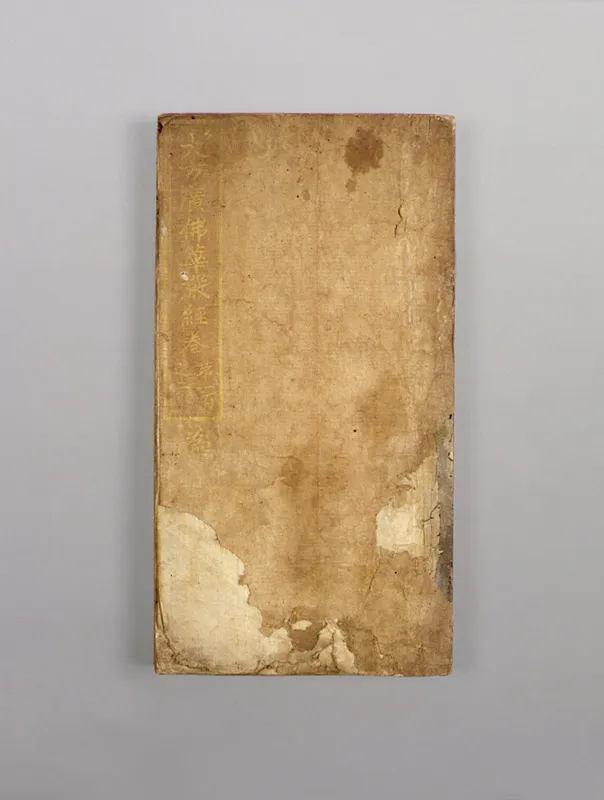
Daebanggwangbulhwaeomgyeongso Gwon28~30, Gwon100~102
大方廣佛華嚴經疏 卷二十八~三十, 卷一百~一百二
서울특별시 서대문구
Basic information
- Designation
- Treasure No.892
- Category
- Books & Records
- Designated year
- 1986
- Location
- 서대문구, 서울특별시— 서울특별시 서대문구 충정로9길 10-10 (충정로2가) (재)현담문고
- Coordinates
- 37.564993, 126.964911Kakao address conversion
AI Docent
Coming soonAn AI-generated, friendly retelling of this heritage site is available in Korean. An English version is on our roadmap — for now, please see the official description below.
Description
The Commentary on the Avatamsaka Sutra (Flower Garland Sutra), one of the canonical scriptures of Mahayana Buddhism, has annotations by Cheng Deng of the Tang Dynasty and comments by Jing Yuan of the Song Dynasty. The central idea expressed in this sutra is the unity of Buddha and sentient beings. As the most fundamental text for Korean Huayan Buddhism, this sutra has had seminal influence on Korean Buddhist philosophy along with the Saddharmapundarika Sutra (Lotus Sutra). This text is the 42nd of a total of 120 volumes printed with woodblocks sent by author Jing Yuan to Goryeo monk Uicheon in 1087 (fourth year of the reign of King Seonjong of the Goryeo Dynasty). Volumes 28-30 are 32.2cm long and 18.3cm wide, and Volumes 100-102, 34.7cm long and 18.6cm wide. With the intention of printing it in a scroll, the original woodblocks were engraved with 20 lines but were divided into two; every 10 lines were printed on mulberry paper. It was tied up and covered by a thick piece of paper to form a book. The title is written on the cover in gold, and the edge of the book was cut off to be put into a Buddha statue. The woodblocks of this sutra are said to have been given to Japan, which had made numerous requests for a set of Tripitaka Koreana woodblocks, in 1441 (23rd year of the reign of King Sejong of the Joseon Dynasty). The Commentary on the Avatamsaka Sutra is a particularly important text since it holds great significance for the history of Buddhist exchanges between China, Goryeo, and Japan.
Location
지도를 불러오는 중…
Have you visited this place?
Log in and verify your visit on-site via GPS to record a stamp in My Journey. (QR verification coming later.)
Images: KOGL (khs.go.kr) · Data source: Korea Heritage Service Open API (khs.go.kr)