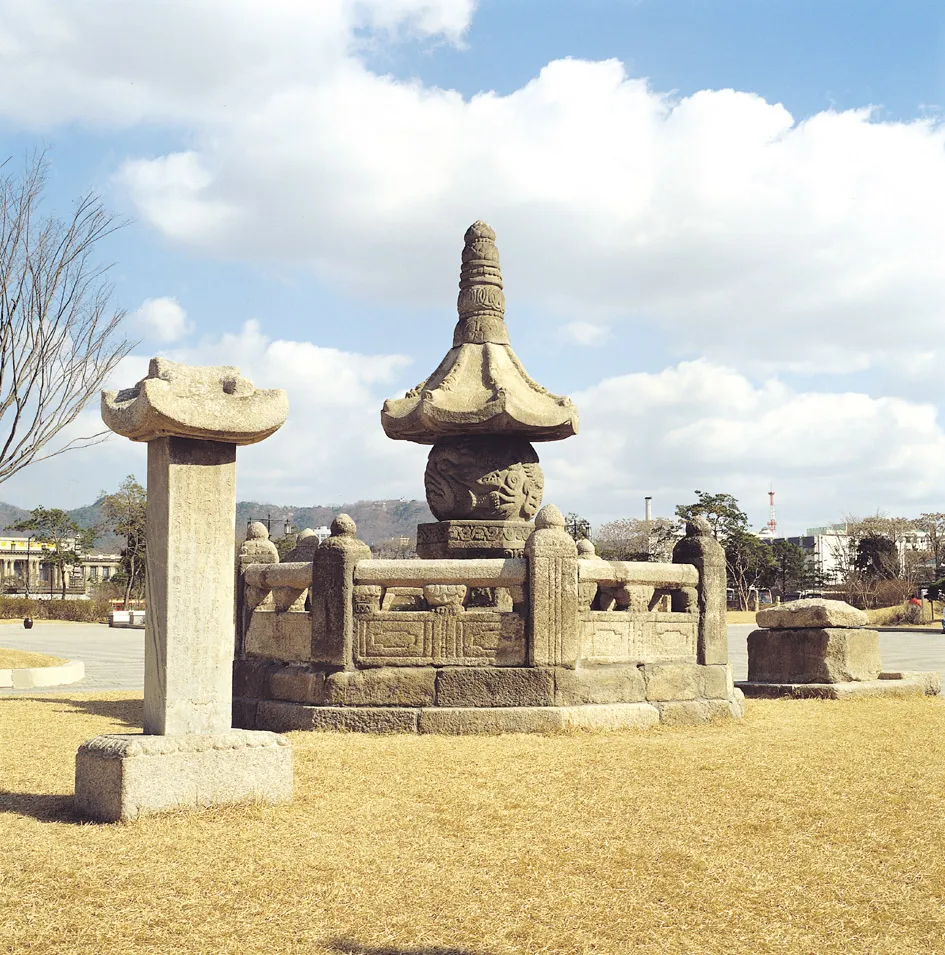
Bonginsa Budoamji Saritap Mit Sarira Reliquary, Namyangju
南楊州 奉印寺 浮圖庵址 舍利塔 및 舍利莊嚴具
서울특별시 용산구
Basic information
- Designation
- Treasure No.928
- Category
- Sites & Pagodas
- Era
- 조선시대
- Designated year
- 1987
- Location
- 용산구, 서울특별시— 서울 용산구 서빙고로 137, 국립중앙박물관 (용산동6가)
- Coordinates
- 37.524041, 126.980350
AI Docent
Coming soonAn AI-generated, friendly retelling of this heritage site is available in Korean. An English version is on our roadmap — for now, please see the official description below.
Description
King Gwanghaegun (r. 1608-1623), the 15th ruler of the Joseon Dynasty, had a stupa built at Budoam Hermitage of Bonginsa Temple, praying for his prince's healthy and long life under the Buddha's protection. It is usual to keep the sarira of a certain Buddhist Monk in a stupa, but this remarkable stupa keeps the Buddha’s sarira. The stupa also went through many difficulties during the Japanese rule in Korea (1910-1945), and it was moved to Japan in 1927 before it was returned home in 1987 after over 60 years. The stupa is formed on an octagonal plane; the platform, which supports the total weight of the stupa, consists of three parts. The round body was placed on the base platform, and the sarira is kept in this part. An octagonal roofstone covered the body with a long finial ornament. The general appearance of this stupa – the round body, the dragonhead carved at the eight corners of slanted roofstone, and the stone guardrail around the pagoda – reminds one of the stupas of Cheongnyongsa Temple and Hoeamsa Temple. This indicates that the same style prevailing in the beginning of the Joseon Dynasty remained even until the mid-Joseon Period. At the top of the pagoda body is a square dug space to keep reliquaries, and seven relics were found here. They are all vessels with cover, including three brass vessels, three silver vessels, and a crystal sarira bottle. A silver vessel was nested in a brass vessel, making three sets in all; each brass vessel contained silk thread, silk fabric, and incense. The lids of the silver vessels were decorated with a design of flying dragon and clouds in gold, and the inscription on the bottom surface proved that these relics were sealed in 1620 (12th year of King Gwanghaegun’s reign). It is very interesting to see the attempt at a new style as well as the stupa. For example, only a couple of sarira vessels were put in a stupa during those days, yet this stupa contained seven vessels; the finial ornament was also made much longer than any other stupa built during the same period. This stupa is one of the typical works from the mid-Joseon Period with a confirmed age record, playing an important role of providing basic data for studying the cultural heritage of the Joseon Dynasty.
Location
지도를 불러오는 중…
Have you visited this place?
Log in and verify your visit on-site via GPS to record a stamp in My Journey. (QR verification coming later.)
Images: KOGL (khs.go.kr) · Data source: Korea Heritage Service Open API (khs.go.kr)