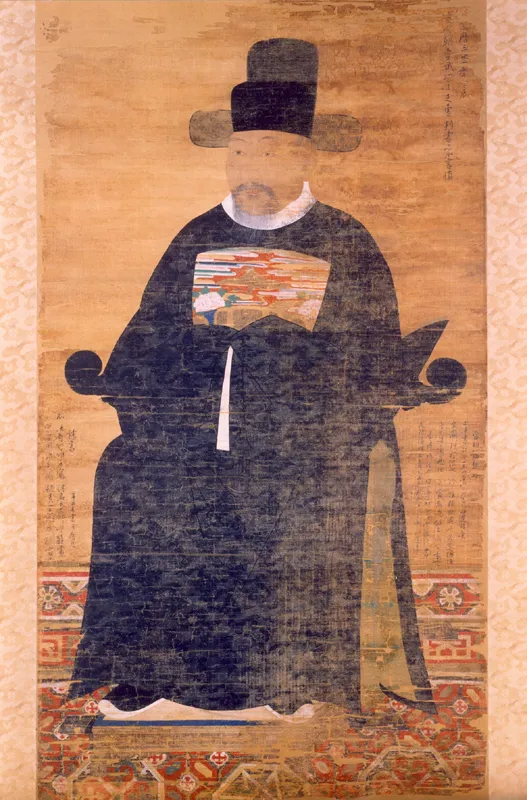
Portrait of Songeonsin
宣祖御書賜 宋言愼 密札帖 및 宋言愼 肖像 - 宋言愼 肖像
경기도 용인시
Basic information
- Designation
- Treasure No.941-2
- Category
- Painting
- Era
- 조선시대(17세기 초)
- Designated year
- 2004
- Location
- 용인시, 경기도— 경기 용인시 기흥구 상갈로 6, 경기도박물관 (상갈동)
- Coordinates
- 37.268330, 127.108756
AI Docent
Coming soonAn AI-generated, friendly retelling of this heritage site is available in Korean. An English version is on our roadmap — for now, please see the official description below.
Description
The portrait depicts the full figure of Song Eon-sin sitting in a chair wearing a ceremonial robe, a tall hat, and a topcoat. The rank badge on the breast is embroidered with peony, wild geese, and clouds, and the golden belt around his waist indicates his official rank at the time from 1603 to 1614. He served as inspector-general and minister of personnel, both of which fell under the category of senior grade of the second rank. His face and body are slightly turned to the right, exposing more of his left side. His folded hands are hidden in the sleeves, between which the hems of his white shirt are visible. The arms of the chair, projected outward, represent the earlier mode of expression than that of portraits of other meritorious subjects including Yi Jung-ro. A carpet is laid on the floor, and his feet, wearing black leather shoes, rest on the footstool. The bottom half of the tall hat is painted black, whereas the upper half is dark grey. Because this technique is typical of the portraits in the later era, some retouch of color is assumed to have been done even before the restoration. The face has an ocher yellow tint, and the eyebrows are depicted in detail down to the hair. The outline of the face is drawn in darker ocher. The pupils are black, and the other parts of the eyes are dark grey. The face is hardly shaded, but slight shade is applied to the furrow alongside the nose, cheeks, and outer orifice of the ear. The beard is treated with black lines, along which slightly wavy white lines are added. The white of the undershirt is peeled off slightly, and the lines along which the contrasting colors of the shirt and topcoat meet are not clear-cut. Given the fact that the restoration procedure emphasized the preservation of the original as it was, the lines must have been rough initially. Although the outline of the topcoat is mostly round, the sleeves and their creases are notably angular. The wrinkles in the clothes are expressed with a few simple lines. The patterns on the coat fabric have been rubbed off a lot; the design of the carpet is not vivid. The color in the lining cloth is smeared, and the strings are revealed between the side-slit of the topcoat. The texture of the silk canvas is so coarse that its warp and weft are visible. The edges of the silk canvas are a bit frayed. It is hard to tell exactly when the portrait and its script were produced, but the script is assumed to have been written after the year King Gwanghaegun acceded to the throne (1608) because the word in the main title “Seonjong (宣宗)” was the posthumous name of King Seonjo, which started to be used after that year. The phrase “the spring of the Sinhae (辛亥) year” on the left part of the background is presumed to be the spring of 1611, a year before Song Eon-sin passed away. The word “Gwanggeo (廣居)” is also believed to indicate Bangam in Gwangju, the place where he lived in retirement. The painting shows the characteristics typical of portraits of meritorious subjects in the early 17th century with its expression of the creases in the clothes and the posture of Song Eon-sin sitting in a chair slightly turned to the right on a carpet.
Location
지도를 불러오는 중…
Have you visited this place?
Log in and verify your visit on-site via GPS to record a stamp in My Journey. (QR verification coming later.)
Images: KOGL (khs.go.kr) · Data source: Korea Heritage Service Open API (khs.go.kr)