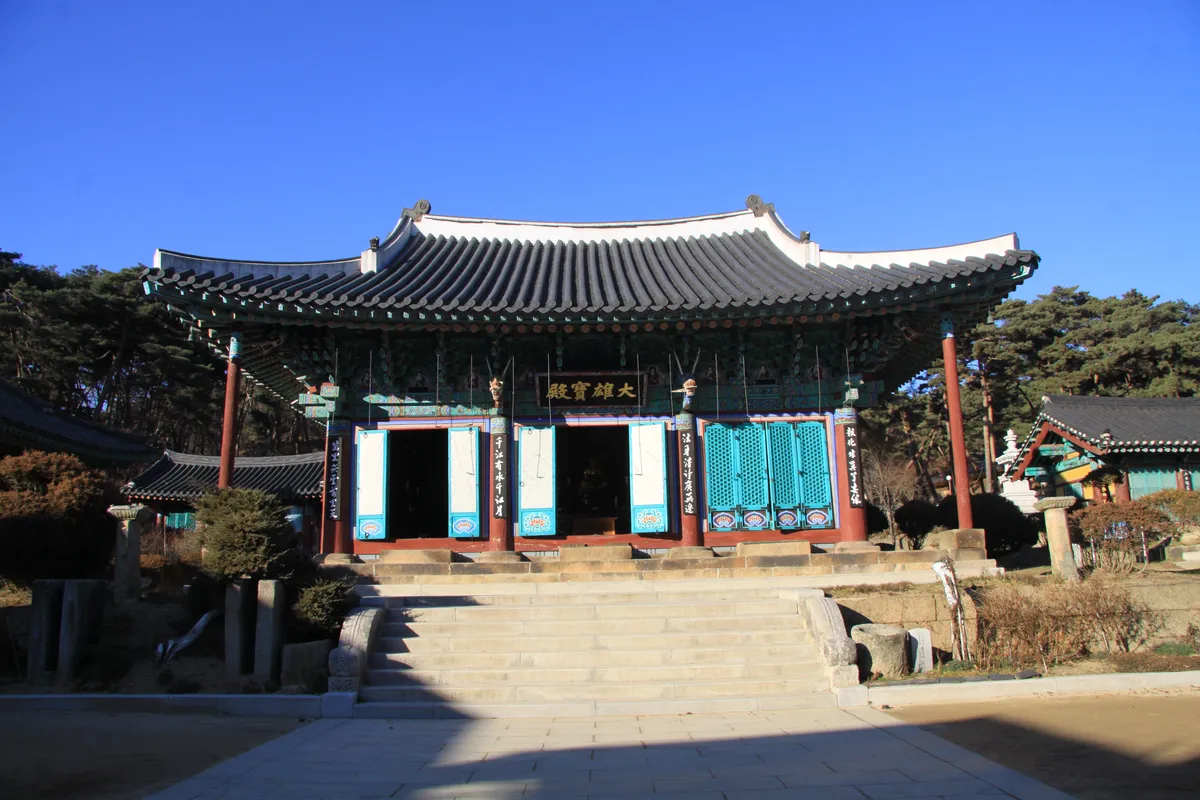
Yongjusa Daeungbojeon Hall, Hwaseong
華城 龍珠寺 大雄寶殿
경기도 화성시
Basic information
- Designation
- Treasure No.1942
- Category
- Architecture
- Era
- 조선시대
- Designated year
- 2017
- Location
- 화성시, 경기도— 경기도 화성시 용주로 136 (송산동, 용주사)
- Coordinates
- 37.212433, 127.004984
AI Docent
Coming soonAn AI-generated, friendly retelling of this heritage site is available in Korean. An English version is on our roadmap — for now, please see the official description below.
Description
Daeungbojeon Hall of Yongjusa Temple is in a good state of preservation apart from the external dancheong (Korean traditional decorative painting of wooden buildings and artifacts) patterns, despite having undergone repairs on several occasions. The hall measures 3 kan* by 3 kan, and has a hipped-and-gable roof with brackets under the eaves, typical features of Buddhist architecture of the eighteenth century. Certain architectural features - such as the rectangular stone platform, square cornerstones with a round hole into which the columns were slotted, decorative roof ridge tiles, and the application of lime plaster to the surface of the top ridge, vertical ridge, and descending ridge – indicate that the building was used as a temple where rites were performed for the protection of a royal tomb. The bracket system installed to support the roof and the carving techniques are also characteristic architectural features of the period when it was first founded. The decorative patterns and carvings of the altar and the baldachin, the base blocks of the brackets and elaborate curlicue ornamentations at the top of each pillar, the dragon-shaped carvings on the beams, and the dancheong (Korean traditional decorative coloring on wooden buildings and artifacts), etc. create a pleasant harmony with the other decorative features of the temple. The Main Hall was built by first-rate monk craftsmen of the time, including Muneon of Cheongwansa Temple in Jangheung, who served as the head carpenter, and Mingwan, who was in charge of the dancheong.
Location
지도를 불러오는 중…
Have you visited this place?
Log in and verify your visit on-site via GPS to record a stamp in My Journey. (QR verification coming later.)
Images: KOGL (khs.go.kr) · Data source: Korea Heritage Service Open API (khs.go.kr)