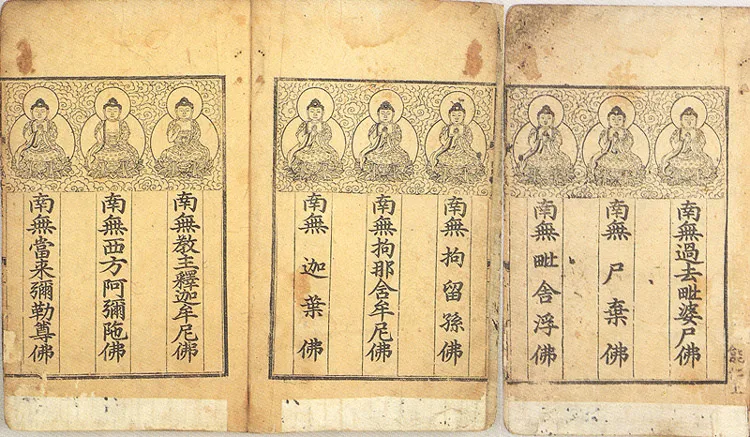
Yenyeommitadoryangchambeop
禮念彌陀道場懺法
서울특별시 용산구
Basic information
- Designation
- Treasure No.949
- Category
- Books & Records
- Era
- 조선 성종 5년(1474)
- Designated year
- 1988
- Location
- 용산구, 서울특별시— 서울특별시 용산구 서빙고로 137 (용산동6가, 국립중앙박물관)
- Coordinates
- 37.524041, 126.980350
AI Docent
Coming soonAn AI-generated, friendly retelling of this heritage site is available in Korean. An English version is on our roadmap — for now, please see the official description below.
Description
“Chambeop” refers to a Buddhist penitence rite during which sutras are recited as part of the ritualistic act of penitence. When the penitence ritual is addressed to Amitabha Buddha of the Pure Land, this is called Mita chambeop (Amitabha Penitence Rite). It had been prevalent since the Three Kingdoms’ Period because there was a great number of Buddhists who want to be reborn in Buddhist Paradise. Printed on mulberry paper after it was carved on woodblocks, this book consisted of two books: one contained Volumes 1 to 5, and the other, Volumes 6 to 10. It measures 24 cm wide and 37 cm long. Its title Jeongtomun, or The Gate to Paradise, is written on the yellowish green cover made of cloth. Three Buddha images -- the past, present, and future Buddhas -- were described on the preface, with the postscript by Kim Su-on added at the end of this book. The postscript also provides the list of names of prominent monks and royals who took part in the carving of the printing blocks along with their titles and ranks, indicating that the publication of this book was a high-profile project directly sponsored by the royal house. Since the royal family was in charge of the book, it was not disseminated in the temples. It was republished at Haeinsa Temple in 1503, and the woodblocks are now included in the Printing Woodblocks of the Tripitaka Koreana in Haeinsa Temple, Hapcheon (National Treasure No. 32). It is considered the most magnificent work done in the early Joseon Period, since people who took charge of writing the book and drew the paintings were first-class writers and painters.
Location
지도를 불러오는 중…
Have you visited this place?
Log in and verify your visit on-site via GPS to record a stamp in My Journey. (QR verification coming later.)
Images: KOGL (khs.go.kr) · Data source: Korea Heritage Service Open API (khs.go.kr)