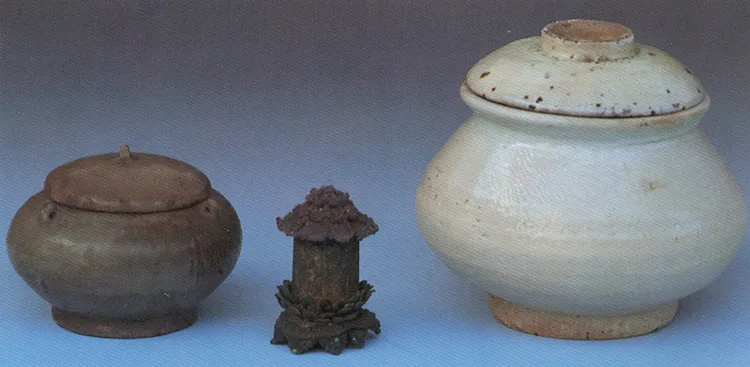
Seonamsa Samcheungseoktap Sarira Reliquary, Suncheon
順天 仙巖寺 三層石塔 舍利莊嚴具
전라남도 순천시
Basic information
- Designation
- Treasure No.955
- Category
- Craft
- Era
- (1418)
- Designated year
- 1988
- Location
- 순천시, 전라남도— 전남 순천시 승주읍 선암사길 450, 선암사 성보박물관 (죽학리)
- Coordinates
- 34.989500, 127.103400Museum-based location
AI Docent
Coming soonAn AI-generated, friendly retelling of this heritage site is available in Korean. An English version is on our roadmap — for now, please see the official description below.
Description
These three relics were discovered when the East and West Three-story Stone Pagodas of Seonamsa Temple, Suncheon (Treasure No. 395) were being dismantled and repaired. The fact that a sarira hole was found in the lower part of a stone pagoda was unprecedented. The relics from the sarira hole include a celadon jar and a white porcelain jar, with the sarira casket found inside the latter. Inside the white porcelain jar was a gilt-bronze miniature pagoda wrapped in silk cloth. One piece of round-shaped, gray white sarira was kept in a crystal bowl in the shape of an octagonal cylinder inside the pagoda. The celadon jar has height of 6.5 cm, mouth diameter of 4.1 cm, base diameter of 5.6 cm, lid diameter of 6.4 cm, and lid height of 1.5 cm. At the center of the upper side of the lid is a small protrusion. The jar has a wide shoulder and a plump body, with a line engraved around the shoulder. An angled protrusion with a hole is located in three different places on the shoulder. The glaze coating has dark verdigris color, and there are minute cracks on the surface. The white porcelain jar has height of 12 cm, mouth diameter of 9.6 cm, base diameter of 7.2 cm, and lid height of 2.6 cm. It has a wide mouth and a plump body that expands from the shoulder. The lid is made in the shape of a small plate, with a protrusion at the center. The surface of the jar is made of white clay and coated with a thick layer of opaque milky-white glaze. It seems to have been produced during the first half of the 16th century. The gilt-bronze miniature pagoda measures 6.2 cm high and 1.9 cm wide. The sarira was kept in this octagonal-shaped pagoda, which was found inside the white porcelain jar. The body of the pagoda is placed on the pedestal in the shape of three-layer lotus leaves, and a roof is placed on top of the body. This miniature pagoda is presumed to have been made around the 14th century. These relics provide valuable information on the reliquaries as well as the metalwork made in the late Goryeo Period.
Location
지도를 불러오는 중…
Have you visited this place?
Log in and verify your visit on-site via GPS to record a stamp in My Journey. (QR verification coming later.)
Images: KOGL (khs.go.kr) · Data source: Korea Heritage Service Open API (khs.go.kr)