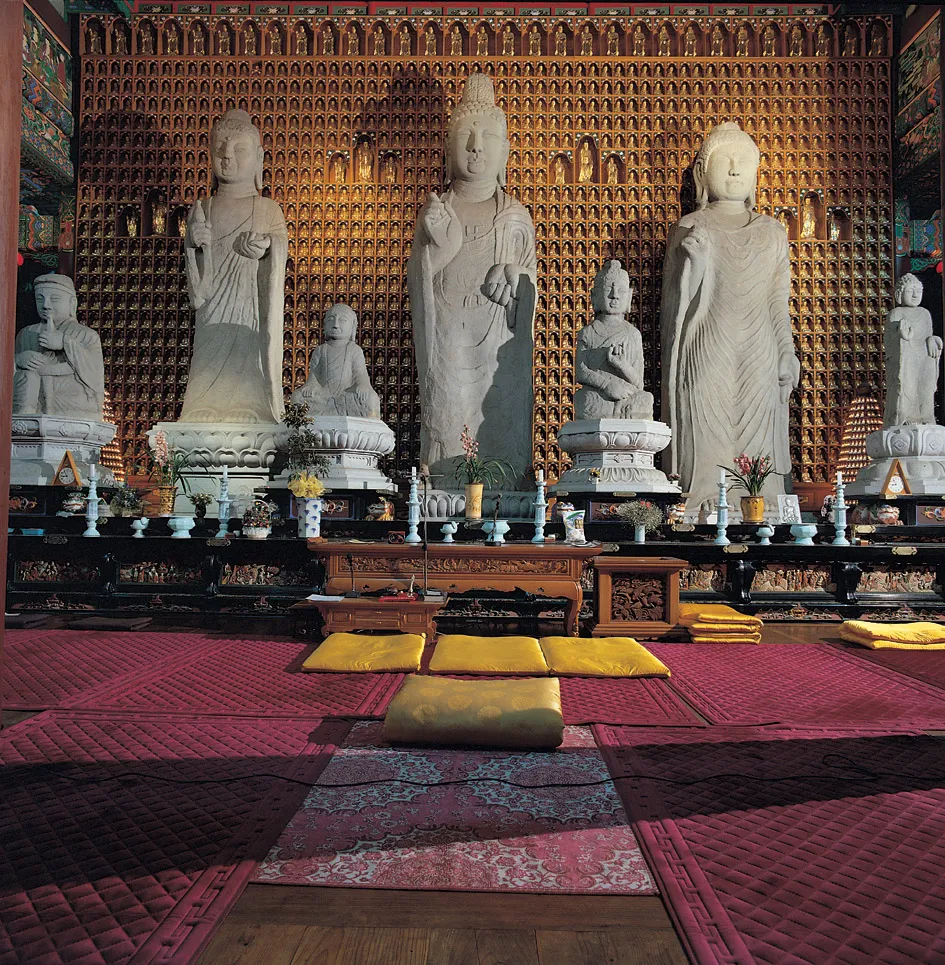
Yonghwasa Seokjobulsanggun, Cheongju
淸州 龍華寺 石造佛像群
충청북도 청주시
Basic information
- Designation
- Treasure No.985
- Category
- Sculpture
- Era
- 고려시대
- Designated year
- 1989
- Location
- 청주시, 충청북도— 충청북도 청주시 서원구 무심서로 565 (사직동, 용화사)
- Coordinates
- 36.641937, 127.482037
AI Docent
Coming soonAn AI-generated, friendly retelling of this heritage site is available in Korean. An English version is on our roadmap — for now, please see the official description below.
Description
According to the tablet on a ridge beam in the sanctum of Yonghwasa Temple, this temple was built in 1902. Legend has it that seven stone statues of Buddha appeared in the dream of Eombi, a consort of King Gojong, requesting her to build a house for them. She sent a person to find the stone statues at the stream northwest of Cheongju. Thus, Yonghwasa Temple was built, with the seven statues of Buddha enshrined in Mireukbojeon Hall of this temple. These statues -- consisting of five Buddha statues and two Bodhisattva statues -- are all large, the tallest one being 550 cm and the shortest being 140 cm. Among them, the 3rd Buddha statue to the left has an extraordinary large usnisa (protrusion on the top of Buddha’s head) rising on the curled hair. The body wearing the sacerdotal robe draped over the shoulders is entirely voluminous, and the Chinese character “卍” is carved in relief on the chest. The fifth Buddha statue to the left has unique pleats, with the big image of arhat carved on the rear side. This arhat seems to have been carved in later times. The standing stone statue of Buddha, which had the head and two hands repaired later, has a large usnisa on the curled hair. These seven Buddha statues are standing, with the seated statues of Buddha wearing sacerdotal robes draped over the shoulders. They are estimated to have been made in the Goryeo Period, judging from the face and detailed technique especially the pleats and hand shape.
Location
지도를 불러오는 중…
Have you visited this place?
Log in and verify your visit on-site via GPS to record a stamp in My Journey. (QR verification coming later.)
Images: KOGL (khs.go.kr) · Data source: Korea Heritage Service Open API (khs.go.kr)