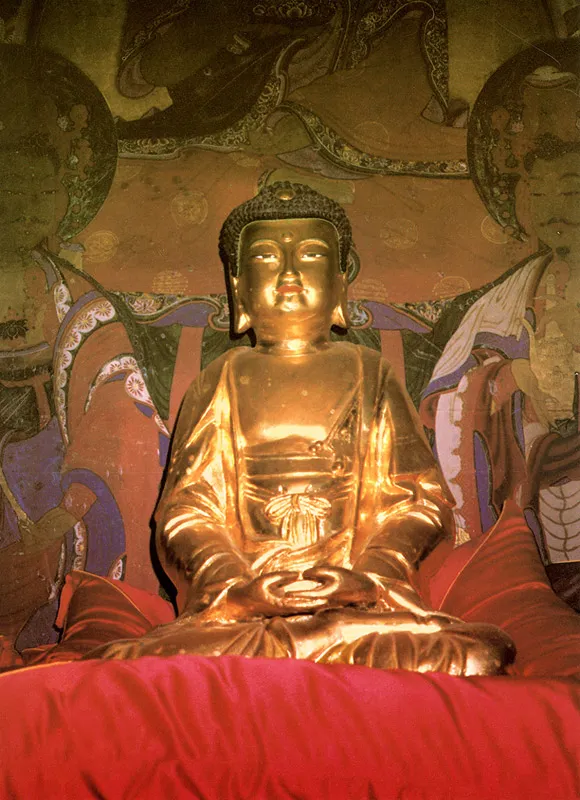
Baekryeonsa Iron Seated Amitabha Buddha, Ganghwa
江華 白蓮寺 鐵造阿彌陀如來坐像
인천광역시 강화군
Basic information
- Designation
- Treasure No.994
- Category
- Sculpture
- Era
- (14세기후반)
- Designated year
- 1989
- Location
- 강화군, 인천광역시— 인천 강화군 하점면 고려산로61번길 270, 백련사 (부근리)
- Coordinates
- 37.751337, 126.437003
AI Docent
Coming soonAn AI-generated, friendly retelling of this heritage site is available in Korean. An English version is on our roadmap — for now, please see the official description below.
Description
Baengnyeonsa Temple was built in 416 (fourth year of the reign of King Jangsu during the Goguryeo Period). Legend has it that one Indian monk was looking for a site to establish a Buddhist temple during the Three Kingdoms’ Period, finally finding a pond filled with five-colored lotus flowers at Goryeosan Mountain on Ganghwado Island. He cut off the flowers to fly them in the air and built temples everywhere the flowers fell. The temple built on the spot where white flowers fell was named Baengnyeonsa, which literally means “Temple of White Lotus.” This iron Buddha statue is enshrined in this temple, following the refined style of the late Goryeo Period. The oval face, well-made eyes, nose, and mouth, narrowed shoulder line, and curved finish on the hands and legs give a moderate, solemn impression. The robe is thick, and the pleats are simple. What makes it distinctive is the type of pleats expressed on the top of the left elbow. The left foot is concealed inside the clothes, but the right foot is exposed. The belt of the robe on the belly has a knot loop and a string that is well-balanced to the left and right. This expression is similar to that of the Buddha statue of Janggoksa Temple in Cheongyang. The robe decoration depicted in a large, bold manner or the hem hanging down to the left calf is slightly different but is very similar to the Seated Gilt-bronze Buddha of Mincheonsa Temple. The decent figure of unique posture and the refined technique suggest that it was a work made in the late 14th or early 15th century.
Location
지도를 불러오는 중…
Have you visited this place?
Log in and verify your visit on-site via GPS to record a stamp in My Journey. (QR verification coming later.)
Images: KOGL (khs.go.kr) · Data source: Korea Heritage Service Open API (khs.go.kr)