Chukseosa Seokjobirojanabuljwasang Mit Mokjogwangbae, Bonghwa
奉化 鷲棲寺 石造毘盧遮那佛坐像 및 木造光背
경상북도 봉화군
Basic information
- Designation
- Treasure No.995
- Category
- Sculpture
- Era
- 통일신라시대
- Designated year
- 1989
- Location
- 봉화군, 경상북도— 경북 봉화군 물야면 월계길 739, 축서사 (개단리)
- Coordinates
- 36.981254, 128.800477
AI Docent
Coming soonAn AI-generated, friendly retelling of this heritage site is available in Korean. An English version is on our roadmap — for now, please see the official description below.
Description
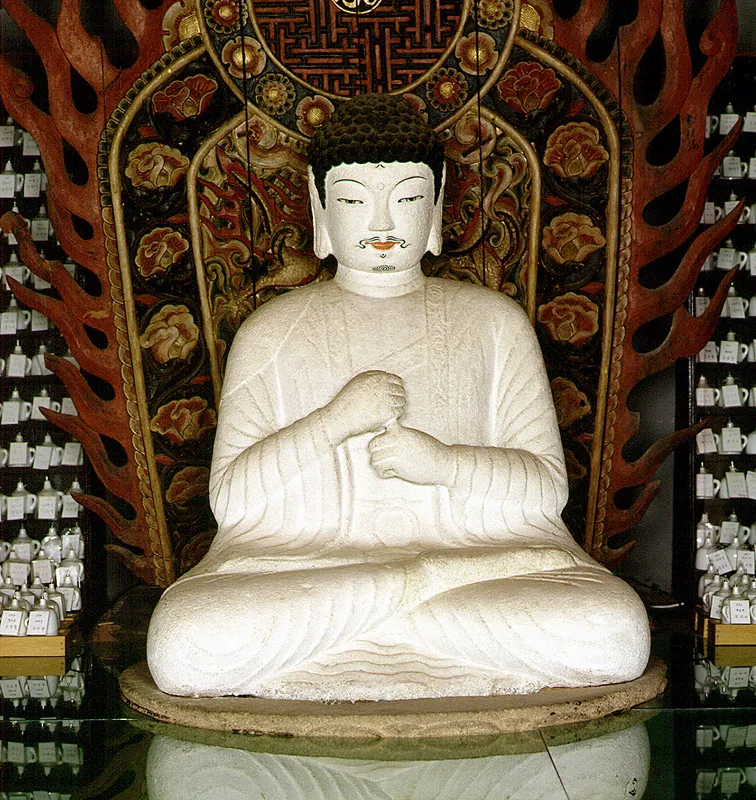
This stone Vairocana Buddha is enshrined at Chukseosa Temple near the peak of Munsusan Mountain, but it is impossible to know where it originally was. The Buddha statue is 108cm tall, with narrow eyes, compressed mouth, and flat, wide body. These characteristics create a feeling of calmness and stability. The robe draped over both shoulders has pleats that form a horizontal tiered style, somewhat demonstrating the schematized aspect. The widely spread pleats in fan shape between the knees have a wave pattern, unlike the U shape of other Buddha statues. This demonstrates well the characteristics of Buddha statues made at the end of the 9th century along with the horizontal tiered style. The pedestal has the octagonal shape prevalent at the end of Silla and consists of the top, middle, and bottom parts. The bottom pedestal has a lion carved in relief on each side of the pedestal; the middle has the figure image gathering the hands together, and the top carries a flower pattern. There is a mandorla made to express the light from the whole body at the rear of the Buddha statue, with the splendid flower and flame pattern carved around it. These patterns were added at a later time. The original mandorla made of stone has only the top part remaining. This Buddha statue, which has the same characteristics as the Stone Seated Vairocana Buddha at Biroam Hermitage of Donghwasa Temple in Daegu (Treasure No. 244), is one of the Vairocana statues commonly made at the end of the Unified Silla Period. It demonstrates the carving technique and type of religion at that time. The inscription of the stone tower shows that it had been made at the end of the 9th century; thus serving as an important material for researching on Buddha statues made at the end of Silla.
Location
지도를 불러오는 중…
Have you visited this place?
Log in and verify your visit on-site via GPS to record a stamp in My Journey. (QR verification coming later.)
Images: KOGL (khs.go.kr) · Data source: Korea Heritage Service Open API (khs.go.kr)