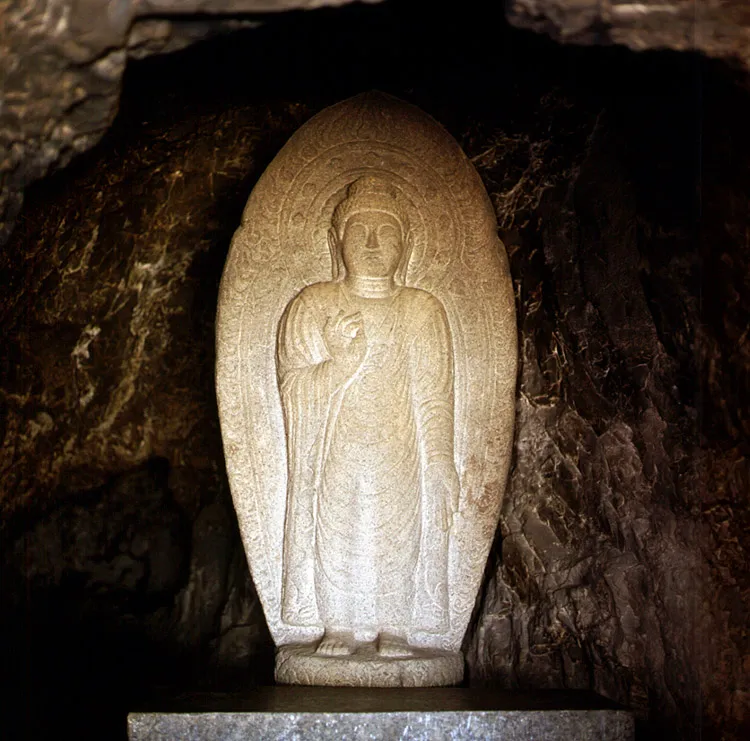
Mitaam Seokjoamitayeorae Standing Figure, Yangsan
梁山 彌陀庵 石造阿彌陀如來立像
경상남도 양산시
Basic information
- Designation
- Treasure No.998
- Category
- Sculpture
- Era
- (8세기전반)
- Designated year
- 1989
- Location
- 양산시, 경상남도— 경남 양산시 주진로 379-61, 미타암 (소주동)
- Coordinates
- 35.405859, 129.131724
AI Docent
Coming soonAn AI-generated, friendly retelling of this heritage site is available in Korean. An English version is on our roadmap — for now, please see the official description below.
Description
This stone Amitabha Buddha is enshrined in a grotto of Mitaam Hermitage, which is said to have been established by Buddhist Monk Wonhyo of Silla. All the characteristics -- such as the large usnisa on the head, long ears drooping to the shoulders, voluminous and polished look, left hand attached on the body, right hand on the chest, round shoulders, flat chest, and upright posture on the pedestals – follow the style of the Stone Standing Amitabha Buddha of Gamsansa Temple in Gyeongju (National Treasure No. 82) created in 719. The sacerdotal robe draping the entire body while making soft U-shaped pleats hangs down and gets symmetrical at the ankle. The mandorla, which expresses the brilliance of the body, has the shape of a sharp-pointed boat. The two thick lines inside it express the head and body mandorlas. The flower patterns are symmetrically arranged between them, and the flame pattern surrounds the edge. The pedestal has a low-cut eye image carved on a rectangular base, on which double flower-patterned carved lotus seats are put. The style and technique of mandorla, pedestal, and pleats are similar to those of the Stone Standing Amitabha Buddha of Gamsansa Temple, suggesting that this statue is a work created during the Unified Silla Period. This statue is enshrined in a grotto, where five monks trained themselves before going to the Western Paradise. Mitaam Hermitage is a natural cave, but there is clear artificial trace displaying the style of Buddha statues made in the 8th century during the Unified Silla Period. It is regarded as an important work for studying the development process of the Amitabha philosophy in Silla as well as the structures of the cave temple prevalent at that time.
Location
지도를 불러오는 중…
Have you visited this place?
Log in and verify your visit on-site via GPS to record a stamp in My Journey. (QR verification coming later.)
Images: KOGL (khs.go.kr) · Data source: Korea Heritage Service Open API (khs.go.kr)