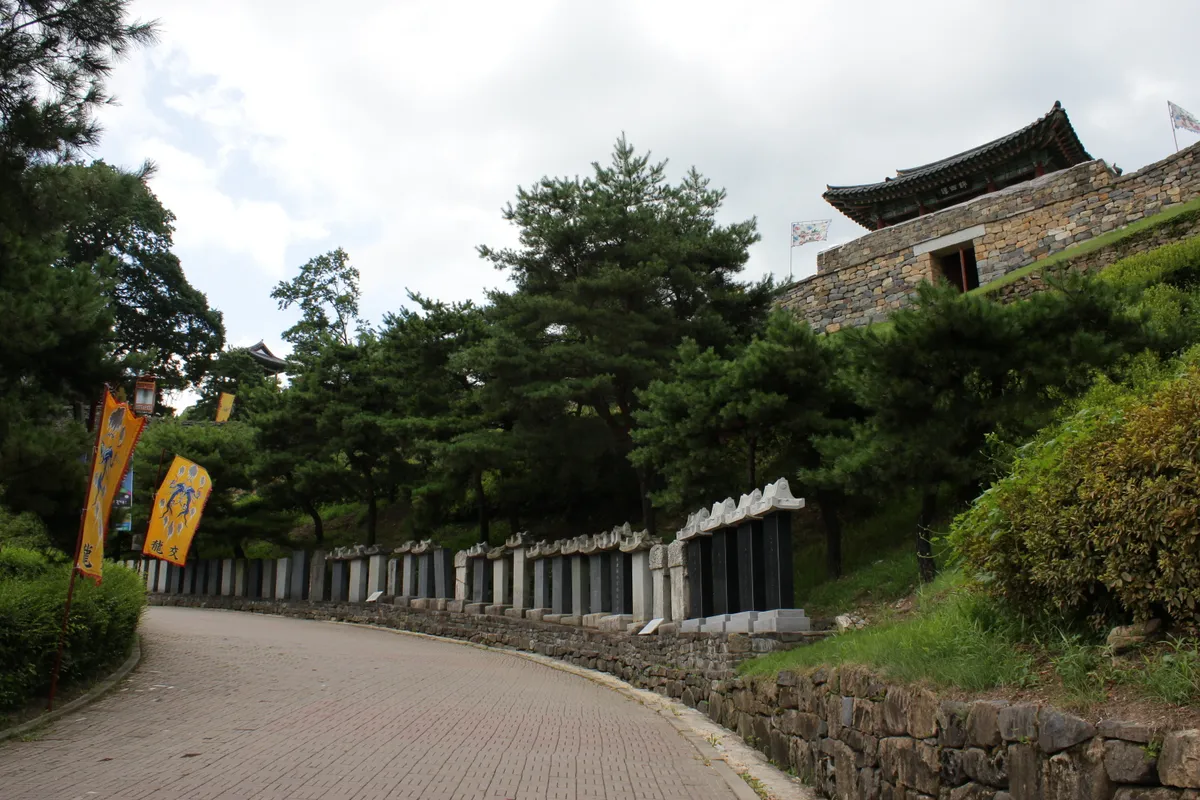
Gongsanseong Fortress, Gongju
公州 公山城
충청남도 공주시
Basic information
- Designation
- Historic Site No.12
- Category
- Sites & Pagodas
- Era
- 삼국시대
- Designated year
- 1963
- Location
- 공주시, 충청남도— 충남 공주시 산성동 2번지
- Coordinates
- 36.463881, 127.126520
AI Docent
✨ AI-generated# Gongsanseong Fortress, Gongju Welcome to Gongsanseong Fortress, where ancient power once flowed! Perched in the Geumgang River area, this fortress protected Gongju when it was the heart of the Baekje Dynasty. Originally built with earthen walls, it was reinforced with stone during the Joseon era. Imagine standing at one of four gates—two restored in 1993—gazing across military facilities, temples, and pavilions. You'll walk where King Uija sheltered after Baekje's fall and where the Restoration Movement gained strength. Even kings of later dynasties sought refuge here during turbulent times. Archaeologists have uncovered beautiful lotus-patterned tiles, pottery, and relics spanning centuries. Though the fortress served as the royal seat until 538, it never lost importance—remaining a regional stronghold through Goryeo and Joseon dynasties. This layered history makes Gongsanseong not just a fortress, but a living chronicle of Korean dynasties.
⚠ This is an AI-generated retelling of the official description. For accuracy, refer to the official description below.
Description
A fortress in the Geumgang River area, Gongsanseong is one of the earliest walls made to protect Gongju, the capital of the Baekje Dynasty. It was originally earthen walls but rebuilt with stones in the Joseon Dynasty. The exact date of its construction is unknown. What is known is that it was called Ungjinseong Fortress during the Baekje Dynasty, Gongjusanseong Fortress or Gongsanseong Fortress during the Goryeo Dynasty, and finally Ssangsusanseong Fortress since the Joseon Dynasty. There were four gates in the fortress, but only two of them remained before 1993: Jinnamnu Pavilion in the south and Gongbungnu Pavilion in the north. In 1993, the other two gates, Yeongdongnu Pavilion in the east and Geumseoru Pavilion in the west were restored. Other remains include -- in addition to a number of military facilities -- Ssangsujeong Pavilion, Yeongeunsa Temple, Yeonji Pond, Imnyugak Pavilion site, and Manharu Pavilion site. Many pieces of Baekje tiles including the lotus-patterned one, earthenware, and other relics from the Goryeo and Joseon Dynasty were also found. This is the place where King Uija stayed for a short time after the fall of the Baekje Dynasty and where the Baekje Restoration Movement got its power. It is also where the rebellion by Kim Heon-chang (822) took place in the Unified Silla Dynasty and where King Injo of the Joseon Dynasty took refuge following the revolt by Yi Gwal (1623). It had been the capital of Baekje Dynasty until King Seong moved it to Buyeo in 538; since then, it has continued to be treated as an administrative hub of the region.
Location
지도를 불러오는 중…
Have you visited this place?
Log in and verify your visit on-site via GPS to record a stamp in My Journey. (QR verification coming later.)
Images: KOGL (khs.go.kr) · Data source: Korea Heritage Service Open API (khs.go.kr)