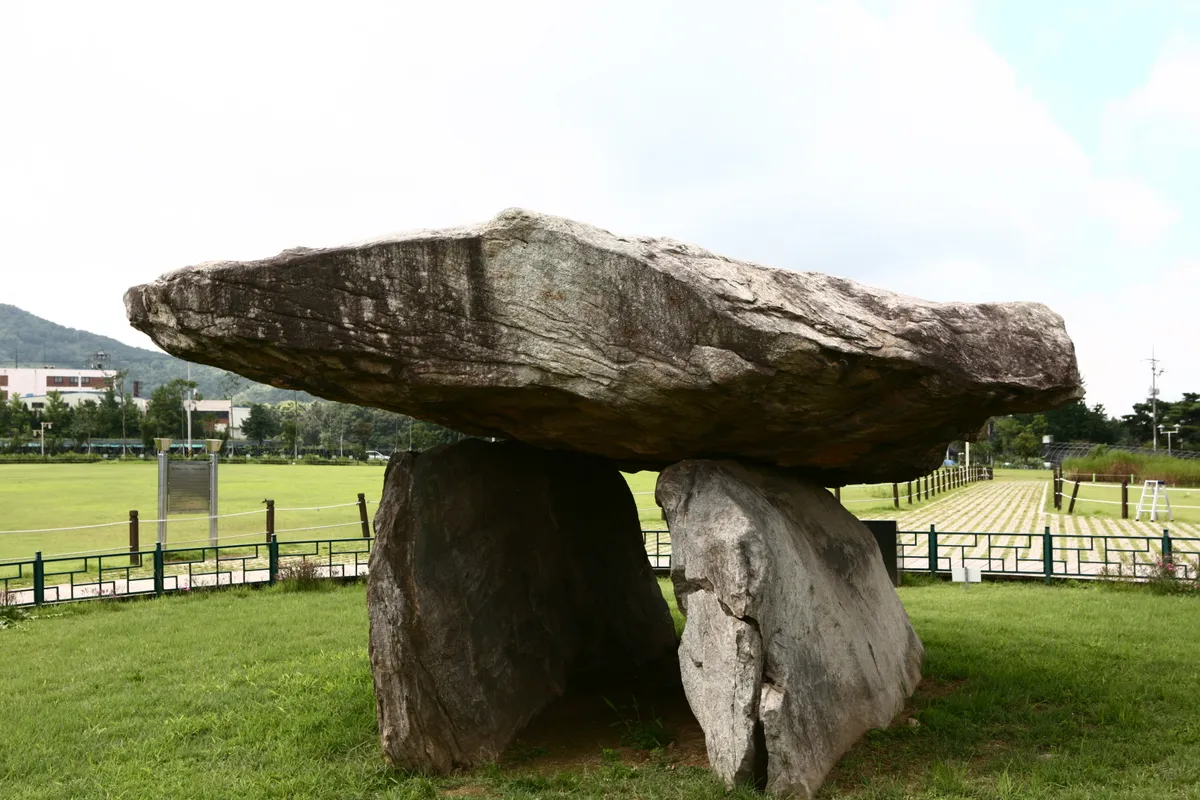
Bugeun-ri Dolmen, Ganghwa
江華 富近里 支石墓
인천광역시 강화군
Basic information
- Designation
- Historic Site No.137
- Category
- 유적지
- Era
- 청동기시대
- Designated year
- 1964
- Location
- 강화군, 인천광역시— 인천 강화군 하점면 부근리 317번지
- Coordinates
- 37.774242, 126.436660
AI Docent
✨ AI-generated# Bugeun-ri Dolmen, Ganghwa Stand before Bugeun-ri Dolmen, and you're facing a Bronze Age burial monument built thousands of years ago. This massive stone structure—called a *jiseongmyo*—rises 2.6 meters high, topped by a granite slab so enormous it stretches 6.5 meters long and weighs tons. Imagine the effort required to position such a stone! What makes this dolmen special? It represents the northern style: four stone walls capped by that impressive flat stone, like a giant desk. Among roughly 40 dolmens in the area, Bugeun-ri stands out as the first huge northern-style mound. Though never excavated, artifacts discovered nearby—pottery pieces, polished stone daggers, and spinning wheels—suggest what lies within. Bugeun-ri holds a unique place in understanding how ancient northern dolmen cultures flourished at this southern location. It's archaeology you can touch with your eyes.
⚠ This is an AI-generated retelling of the official description. For accuracy, refer to the official description below.
Description
The dolmen was erected in the Bronze Age and was called Jiseongmyo. There were two dolmen styles: the northern one consisting of four stone sides topped by a large flat stone shaped like a desk, and a southern one consisting of a large plat stone supported by small stones. Among the 40 dolmens surrounding Hajeom-myeon, Ganghwa-gun, Bugeun-ri Dolmen was the first huge mound on the north. The total height of the dolmen was 2.6 meters. The granite lid stone was 6.5 meters long, 5.2 meters wide, and 1.2 meters thick. Although the dolmen had not been excavated, it seems to be the similar Bugeun-ri Dolmen since relics including pieces of pattern-less pottery, polished stone dagger, and spinning wheel were unearthed around there. It is important in studying the large northern dolmen located at the southern end.
Location
지도를 불러오는 중…
Have you visited this place?
Log in and verify your visit on-site via GPS to record a stamp in My Journey. (QR verification coming later.)
Images: KOGL (khs.go.kr) · Data source: Korea Heritage Service Open API (khs.go.kr)