Dwelling Site and Dolmens in Deogeun-ri, Paju
坡州 德隱里 住居址와 支石墓群
경기도 파주시
Basic information
- Designation
- Historic Site No.148
- Category
- 유적지
- Era
- 청동기시대
- Designated year
- 1966
- Location
- 파주시, 경기도— 경기 파주시 월롱면 덕은리 산46번지
- Coordinates
- 37.814694, 126.779175
AI Docent
Coming soonAn AI-generated, friendly retelling of this heritage site is available in Korean. An English version is on our roadmap — for now, please see the official description below.
Description
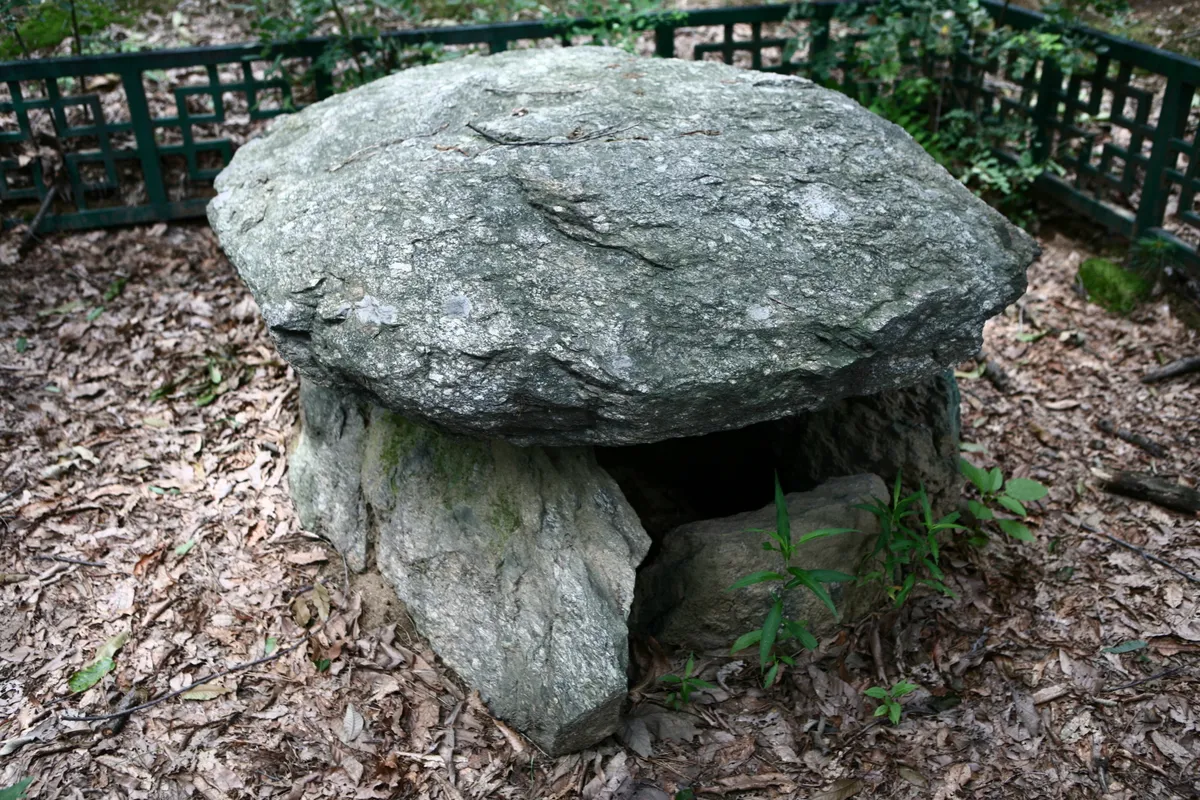
Jiseongmyo or Goindol is a kind of dolmen that was the predominant form of burial during the Korean Bronze Age. In Korea, there are two types: the so-called bukbangsik (northern style) looks like a table, whereas nambangsik (southern style) consists of only a boulder or one placed atop smaller rocks. Relics such as stone axe and grindstone were found in the dolmen, with the biggest boulder measuring 3.3m long and 1.9m wide. Under the dolmen, the dugout site of the prehistoric age, which has depth of 40-90 cm, length of 157 cm, and width of 370 cm, was unearthed. There are small holes for pillars along the wall and sites of 2 stoves. The traces of burning on the wall and the ashes on the floor suggest that the dugout has been burnt down. The dugout site, shaped like a long square, has also been found in the relics of Yeoksam-dong in Seoul, Gyoha-ri in Paju. Lots of relics were unearthed such as earthenware carved with pattern of holes, polished stone daggers, stone axes, and spinning wheels. Assuming that the dugout was built around 7th Century BC, the dolmen is believed to have been made after the 7th century. This relic is important evidence that polished stone daggers started to be made earlier than the Korean-style slender bronze dagger, which began to be made around the 4th century. It also shows the culture of using vessels carved with the pattern of holes around the 7th century.
Location
지도를 불러오는 중…
Have you visited this place?
Log in and verify your visit on-site via GPS to record a stamp in My Journey. (QR verification coming later.)
Images: KOGL (khs.go.kr) · Data source: Korea Heritage Service Open API (khs.go.kr)