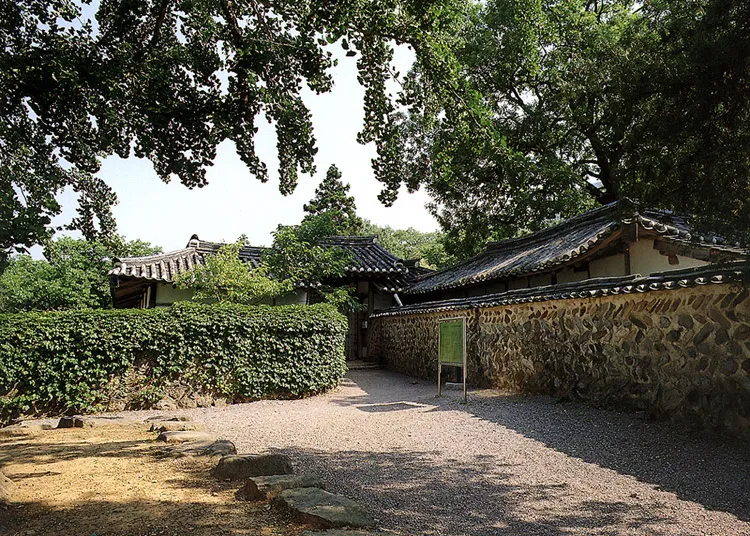
Nogudang House of the Haenam Yun Clan and Surroundings
海南尹氏 綠雨堂 一圓
전라남도 해남군
Basic information
- Designation
- Historic Site No.167
- Category
- Architecture
- Era
- 조선시대
- Designated year
- 1968
- Location
- 해남군, 전라남도— 전남 해남군 해남읍 녹우당길 135 (연동리)
- Coordinates
- 34.551196, 126.622656
AI Docent
Coming soonAn AI-generated, friendly retelling of this heritage site is available in Korean. An English version is on our roadmap — for now, please see the official description below.
Description
As the ancient house of Yun Seon-do, this house was built by Hyojeong (1476-1543), the great-great grandfather of Yun Seon-do who settled in Yeondong in the mid-15th century. It is located on a superfine site, with Deogeumsan Mountain at the back and the ridge of the Byeorubong and Pilbong peaks in front. As soon as one passes the front gate and enters the yard of sarangchae (men's quarters), one can see a small pond at the southeast corner of the wall. Sarangchae is said to have been granted by King Hyojong, who was the disciple of Yun Seon-do, to Yun Seon-do when he lived in Suwon, Gyeonggi-do; it was moved here in the 9th year of the reign of King Hyeonjong. Passing the east gate at the back of sarangchae, one will see the main building shaped like ㄷ. A shrine is located right in front of the east wall at the backyard of the main building; other shrines – such as the shrines for Yun Seon-do and Yun Hyo-jeong -- are located outside the wall. At the entrance of the house are the ginkgo trees planted at the time, representing Nogudang; at the back of the house, the mountain is overgrown with Japanese Torreya Forest (Natural Monument No. 241). Cultural assets such as the self-portrait by Yun Du-seo (National Treasure No. 240), Sanjung singokjip (New Songs from the Mountains) (Treasure No. 482), Eobusa sisajip (Song of the Fisherman), etc., and relics numbering more than 3000 are preserved here. With the ㅁ-shaped layout of the main building and the sarangchae and the well-equipped haengnangchae (servants' quarters), it shows the construction style of a house for the high-ranking people of the Joseon Dynasty.
Location
지도를 불러오는 중…
Have you visited this place?
Log in and verify your visit on-site via GPS to record a stamp in My Journey. (QR verification coming later.)
Images: KOGL (khs.go.kr) · Data source: Korea Heritage Service Open API (khs.go.kr)