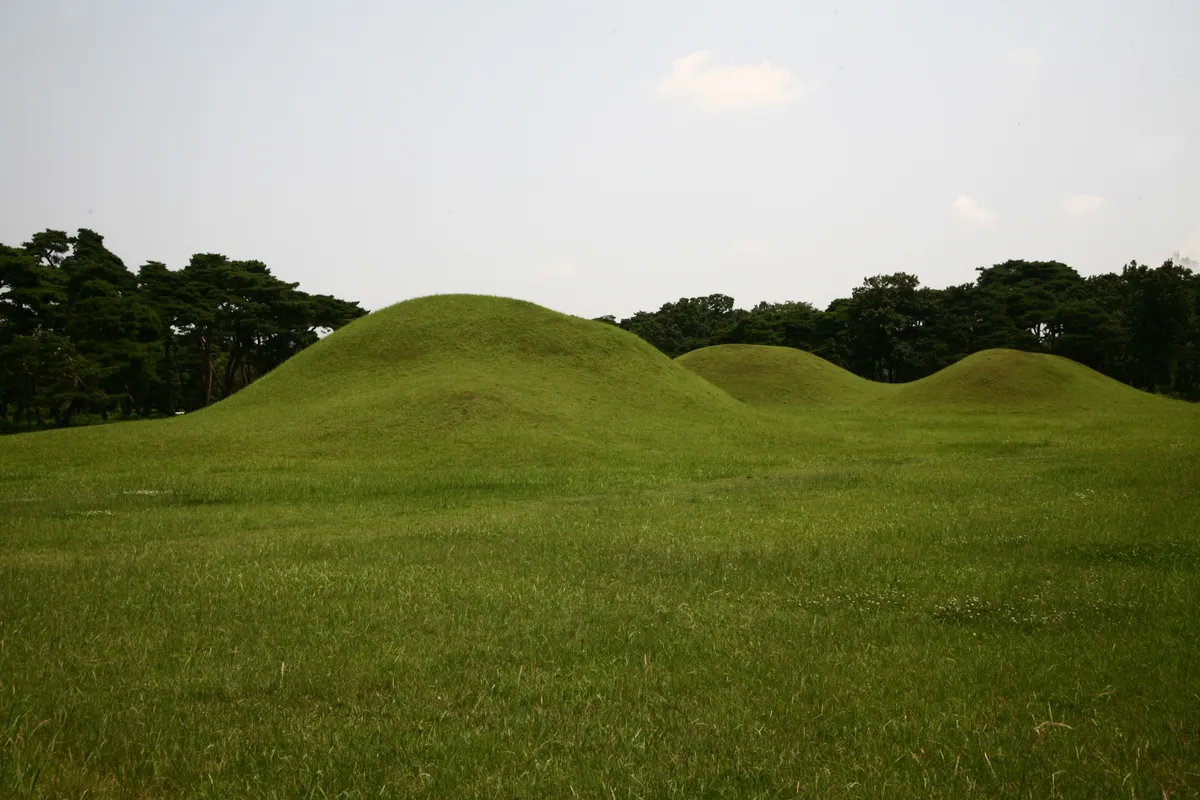
Oreung (Five Royal Tumuli), Gyeongju
慶州 五陵
경상북도 경주시
Basic information
- Designation
- Historic Site No.172
- Category
- 유적지
- Era
- 신라시대(서기 3~111년경)
- Designated year
- 1969
- Location
- 경주시, 경상북도— 경북 경주시 탑동 67번지
- Coordinates
- 35.823069, 129.208462
AI Docent
✨ AI-generatedWelcome to Oreung—five ancient royal tombs nestled in Gyeongju's southwest corner. These aren't just any graves; they belong to early Silla Dynasty royalty, dating back nearly 2,000 years to around the 1st century. Here's what makes them fascinating: no one knows for certain *who* is buried here. Historical records offer competing stories. One account names King Park Hyeokgeose, the dynasty's founder, alongside his queen and three kings. Another tells a mythical tale—that the king ascended to heaven, only for his body to fall back in five pieces, which were each buried separately after a magical snake prevented a single tomb. What you see are simple, rounded earthen mounds. The largest reaches 10 meters high. One uniquely shaped mound, like a gourd, actually holds two people. These imposing tombs reveal something remarkable: such large, grand mounds only became common *after* the 4th century—making Oreung exceptional for its era. Stand here and you're touching nearly two millennia of Korean history.
⚠ This is an AI-generated retelling of the official description. For accuracy, refer to the official description below.
Description
The five tombs are located southwest to the downtown area of Gyeongju. It is uncertain whose tombs they are. Samguk sagi (History of the Three Kingdoms) states that these five tombs are the tombs of King Park Hyeokgeose, founder of the Silla Dynasty (57B.C.-A.D.935), his queen consort Alyeong, Namhae, its second king, Yuri, its third king, and Pasa, its fifth king. According to Samguk yusa (Memorabilia of the Three Kingdoms), however, King Park Hyeokgeose ascended to heaven after ruling for 62 years, and, seven days later, his body, torn into five pieces, fell down from heaven, at which time his consort died after him. As the people tried to bury the five pieces of the king's body in a tomb, a large snake appeared and prevented them from doing so. Hindered by the snake, the people had to bury the royal remains in five separate tombs. The inside structures of the five tombs have never been studied. They are simple, round mound-type tombs of the Old Silla Period commonly found in the Gyeongju area. Among them, the first tomb is the biggest at 10m high; the second tomb, shaped like a gourd, is for 2 people as suggested by its two mounds. These kinds of large-scale, round mound-type tombs were not common during those times, becoming popular only after the 4th century.
Location
지도를 불러오는 중…
Have you visited this place?
Log in and verify your visit on-site via GPS to record a stamp in My Journey. (QR verification coming later.)
Images: KOGL (khs.go.kr) · Data source: Korea Heritage Service Open API (khs.go.kr)