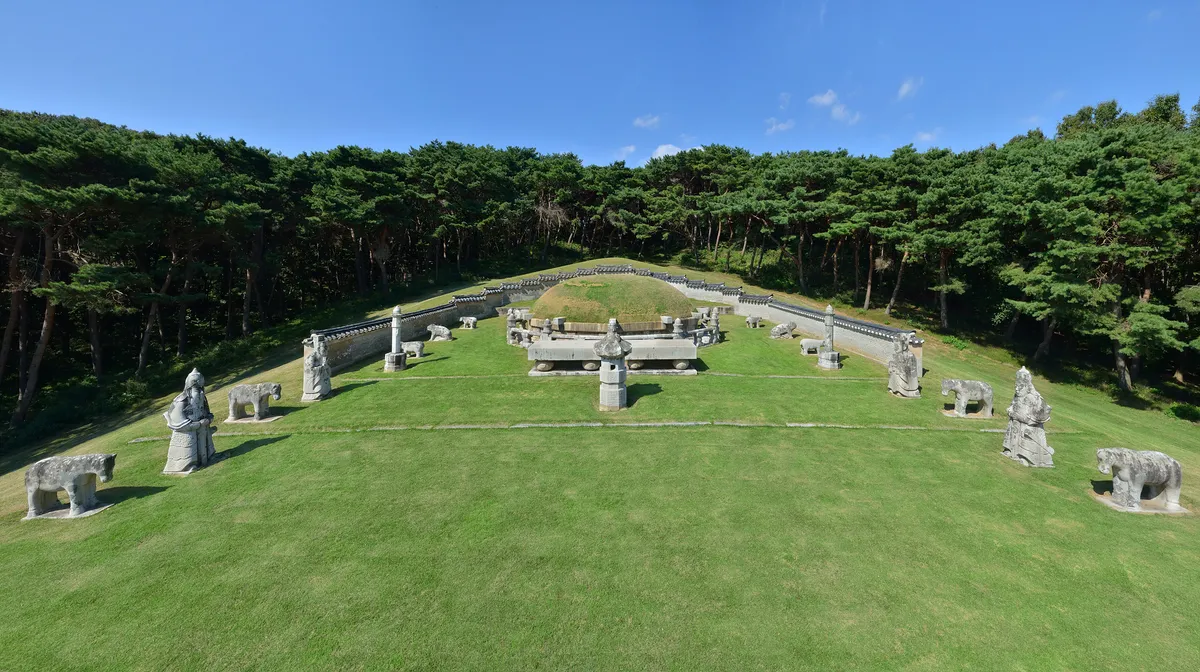
Jangneung Royal Tomb (King Injo), Paju
坡州 長陵
경기도 파주시
Basic information
- Designation
- Historic Site No.203
- Category
- 유적지
- Era
- 조선 영조 7년(1731)
- Designated year
- 1970
- Location
- 파주시, 경기도— 경기도 파주시 장릉로 90 (탄현면)
- Coordinates
- 37.772524, 126.709235
AI Docent
✨ AI-generated# Welcome to Jangneung Royal Tomb You're standing at the resting place of King Injo, the sixteenth king of Joseon, and his queen. King Injo ruled from 1623 onward during turbulent times—Manchu invasions in 1627 and 1636 threatened the kingdom. Yet he worked to rebuild, introducing a groundbreaking tax policy called Daedongbeop to ease his people's suffering. What makes Jangneung special? Look closely at the stone carvings around you. Instead of the traditional twelve zodiac animal figures, you'll see delicate lotus flowers and peonies—a beautiful, distinctive choice that reflects seventeenth-century tastes. These same graceful patterns appear on the stone lantern. The king and queen rest together here, a unified final resting place. The tomb itself has a story: it was originally located elsewhere in Paju but was moved because snakes and scorpions inhabited the original stones. Now, as you walk these grounds, you're witnessing over 290 years of history and royal devotion preserved in stone and earth.
⚠ This is an AI-generated retelling of the official description. For accuracy, refer to the official description below.
Description
This is the tomb where King Injo, the sixteenth king of Joseon, and his wife Queen Inyeol are buried. King Injo, who came to the throne in 1623, did not enjoy a peaceful time during his reign as series of Manchu invasions in 1627 and 1636 swept the country. To improve the impoverished life of his people, he launched a special tax policy called Daedongbeop (Uniform Land Tax Law) in 1623. Jangneung was located in Paju during King Injo’s reign but moved to the current spot as on the stone sculptures around the tomb were inhabited by snakes and scorpions. The graves of king and the queen are placed together in the tomb. Instead of the traditional decorations like the twelve zodiac animal deities, the stone screen is engraved with patterns of lotus flowers and peonies. These patterns, also visible on the stone lantern, are characteristic of the seventeenth century.
Location
지도를 불러오는 중…
Have you visited this place?
Log in and verify your visit on-site via GPS to record a stamp in My Journey. (QR verification coming later.)
Images: KOGL (khs.go.kr) · Data source: Korea Heritage Service Open API (khs.go.kr)