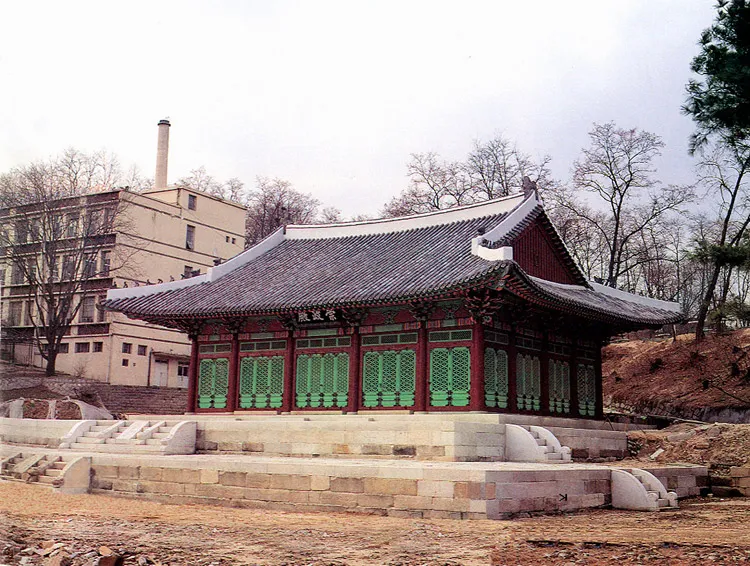
Gyeonghuigung Palace Site
慶熙宮址
서울특별시 종로구
Basic information
- Designation
- Historic Site No.271
- Category
- Sites & Pagodas
- Era
- 조선시대 후기
- Designated year
- 1980
- Location
- 종로구, 서울특별시— 서울 종로구 새문안로 45 (신문로2가)
- Coordinates
- 37.570780, 126.968819
AI Docent
Coming soonAn AI-generated, friendly retelling of this heritage site is available in Korean. An English version is on our roadmap — for now, please see the official description below.
Description
This is a typical case of detached palace of the latter half of the Joseon Dynasty built on site of the house of King Wonjong. The original name of Gyeonghuigung Palace, built in the 8th year of the reign of King Gwanghaegun (1616), had been Gyeongdeokgung Palace, but was renamed in the 36th year of the reign of King Yeongjo (1760). Initially, it had an area of approximately 231,000m2, but it lost its status as a palace by the forced removal during the period from 1907 to 1910 when the nationwide anti-Japan struggle broke out. The palace was severely damaged and reduced to its present size. It had annex buildings – Hoesangjeon, Yungbokjeon, Jipgyeongdang, Heungjeongdang, Sungjeongjeon Halls, Heunghakmun Gate and Hwanghakjeong Pavilion. However, Yungbokjeon and Jipgyeongdang have disappeared. Of the remaining buildings, Hoesangjeon was moved to Jogyesa Temple, Heungjeongdang to Gwangunsa Temple, Sungjeongjeon to Jogyesa Temple first and to Dongguk University later, Heunghwamun Gate to Bangmunsa Temple, and Hwanghakjeong Pavilion to the rear side of Sajik Park. All of these are still preserved today. Currently the base platform of Sungjeongjeon remains, with the terrace stones and some letters carved on a rock, though the stone guardian has been moved. There is a retaining wall built of stone about 100 meters long at the north of the site, and a remarkable dragon head and cloud design carved on the stone stairs to the building can be seen.
Location
지도를 불러오는 중…
Have you visited this place?
Log in and verify your visit on-site via GPS to record a stamp in My Journey. (QR verification coming later.)
Images: KOGL (khs.go.kr) · Data source: Korea Heritage Service Open API (khs.go.kr)