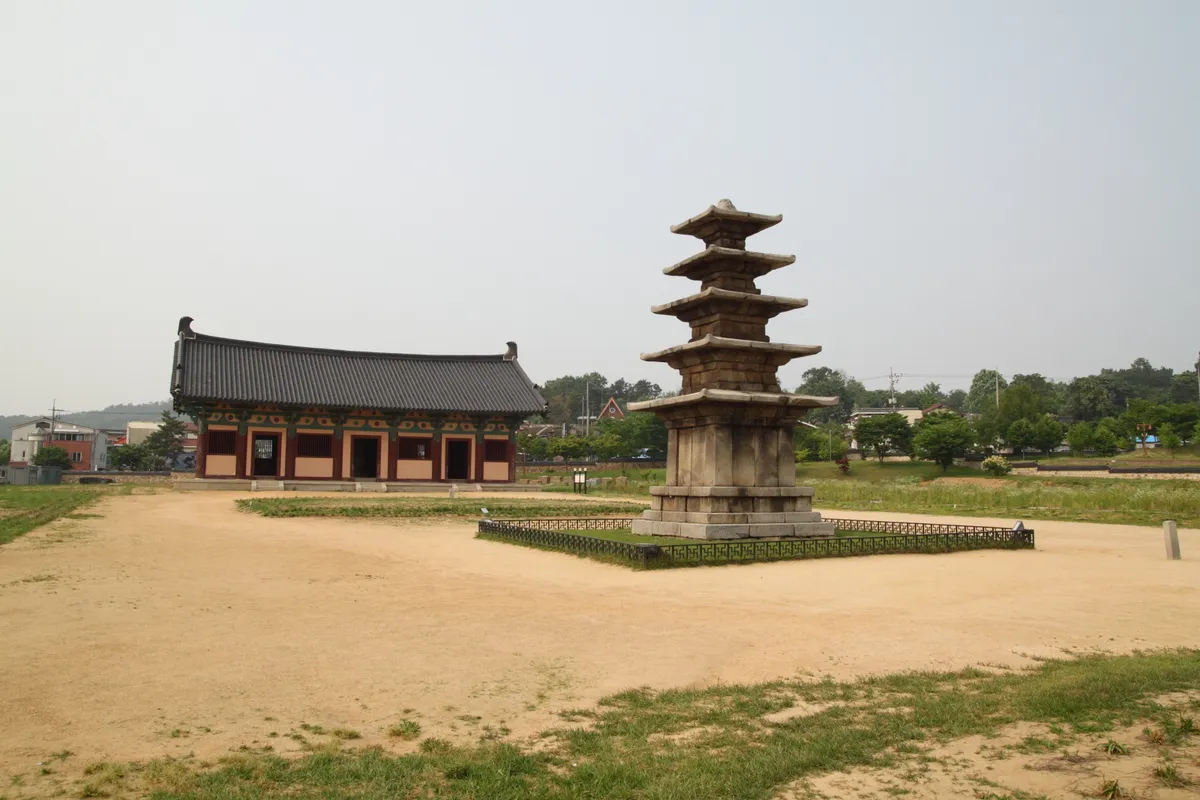
Jeongnimsa Temple Site, Buyeo
扶餘 定林寺址
충청남도 부여군
Basic information
- Designation
- Historic Site No.301
- Category
- 유적지
- Era
- 백제시대
- Designated year
- 1983
- Location
- 부여군, 충청남도— 충남 부여군 부여읍 동남리 254번지
- Coordinates
- 36.278951, 126.915039
AI Docent
✨ AI-generated# Welcome to Jeongnimsa Temple Site Imagine stepping into one of Baekje's most important temples—a spiritual center that stood here from 538 to 660, right when the kingdom was shifting its power base. What makes this place extraordinary is how it bridges two worlds: the original Baekje temple was later rebuilt during the Goryeo Dynasty in 1028, layering centuries of history beneath your feet. Walk the straight path from north to south, passing the central gate, the stunning Five-story Stone Pagoda, and the main halls. The temple's layout—arranged in what experts call "garam style"—was so influential it shaped how temples were designed in ancient Japan. Notice the unique trapezoid-shaped corridors, different from typical temple designs. You'll see the Five-story Stone Pagoda and a seated Buddha statue, both masterpieces. The excavated relics—decorative tiles, pottery, Buddhist sculptures—reveal the vibrant religious and artistic life of Baekje's golden age.
⚠ This is an AI-generated retelling of the official description. For accuracy, refer to the official description below.
Description
The Jeongnimsa Temple Site is where a major temple, Jeongnimsa Temple, stood in the capital movement period from 538 to 660. When the excavation was performed, the writing “8th year of Taepyeong, Mujin Jeongnimsa Temple Daejangdangcho” was discovered on the piece of tile from the site of the auditorium, suggesting that it was Jeongnim Temple in Goryeo Dynasty. The 8th year of Taepyeong corresponds to the year 1028, the 19th year of the reign of King Hyeonjong in Goryeo. In particular, it explains that a building was rebuilt on the site of the auditorium of Baekje Dynasty in Goryeo and was assumed to have been named Daejangjeon Hall. Jeongnimsa Temple has a central line, with Jungmun (central gate), five-story stone pagoda, Geumdang Hall, and auditorium arranged in a straight line from north to south. The garam-style arrangement is made on the plane surrounding Daejangjeon Hall with corridor. These kinds of garam arrangement had an influence on the garam style of the Japanese temple in the 7th century, forming the fundamentals of the garam arrangement of Japanese temple in the ancient times. Still, a special feature of the garam arrangement is that the shape of the corridor surrounding a center of garam arrangement is similar to a trapezoid whose northern gap is wide rather than a square. The pond in front of the temple unearthed by the excavation investigation has been improved, and a hall for the protection of stone seated Buddha was newly constructed in 1933. The Five-story Stone Pagoda (National Treasure No. 9) made in the age of Baekje and the Stone Seated Buddha (Treasure No. 108) made during the Goryeo period remain. The excavated relics include various temple items such as decorative tiles of Baekje and Goryeo, inkstone, earthenware, soil Buddha statue, etc. This indicates the cultural state at that time and serves as representative remains in the age of Baekje.
Location
지도를 불러오는 중…
Have you visited this place?
Log in and verify your visit on-site via GPS to record a stamp in My Journey. (QR verification coming later.)
Images: KOGL (khs.go.kr) · Data source: Korea Heritage Service Open API (khs.go.kr)