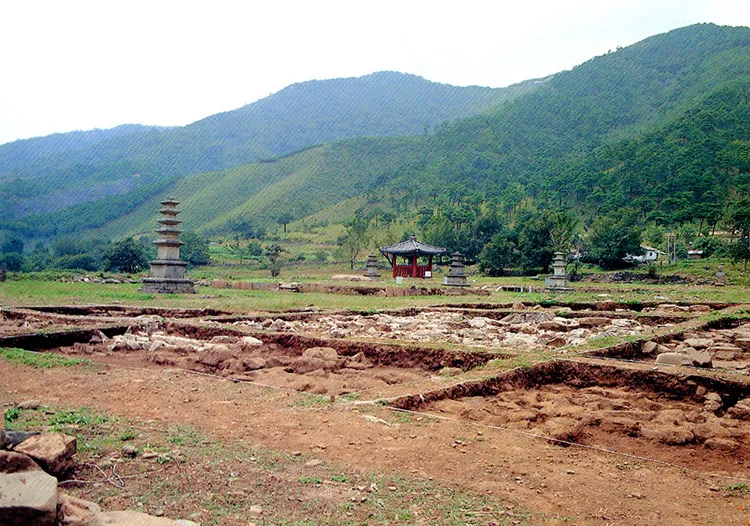
Seongjusa Temple Site, Boryeong
保寧 聖住寺址
충청남도 보령시
Basic information
- Designation
- Historic Site No.307
- Category
- 유적지
- Era
- 신라 문성왕
- Designated year
- 1984
- Location
- 보령시, 충청남도— 충남 보령시 성주면 성주리 72번지
- Coordinates
- 36.344524, 126.655786
AI Docent
Coming soonAn AI-generated, friendly retelling of this heritage site is available in Korean. An English version is on our roadmap — for now, please see the official description below.
Description
It is the site of the Seongjusa Temple, which rested on the southern foot of Seongjusan Mountain. The temple was newly built during the reign of King Beop in the age of Baekje and was called Ohapsa Temple at that time. After Buddhist Monk Nanghye, one of the major monks who returned from China during the reign of King Munseong in Silla, extended the temple to enlarge it, however, it was named Seongjusa Temple. Even though it is a temple that rests on the mountain area, it opted for the Garam type wherein the temple was placed on flat land, unlike other temples. On this temple site are the site of Jungmun (main gate), a stone lamp, and a Five-story Stone Pagoda (Treasure No. 19) as well as Geumdang Hall from the south. The East Three-story Stone Pagoda, Central Three-story Stone Pagoda (Treasure No. 20), and West Three-story Stone Pagoda (Treasure No. 47) are aligned side by side from east to west, with an auditorium at their rear side. The Stele for Buddhist Monk Nanghye (National Treasure No. 8) whose epigraph was written by Choe Chi-won, one of the most famous scholars, is located north-west of the temple. Many relics including the base stone, head of the Buddha statue made by soil in Unified Silla, and tiles in the age of Baekje, Unified Silla, and Goryeo were excavated. Seongjusa Temple was the best temple, with the epigraph of the Stele for Buddhist Monk Nanghye (National Treasure No. 8) the biggest piece of work with very high academic value.
Location
지도를 불러오는 중…
Have you visited this place?
Log in and verify your visit on-site via GPS to record a stamp in My Journey. (QR verification coming later.)
Images: KOGL (khs.go.kr) · Data source: Korea Heritage Service Open API (khs.go.kr)