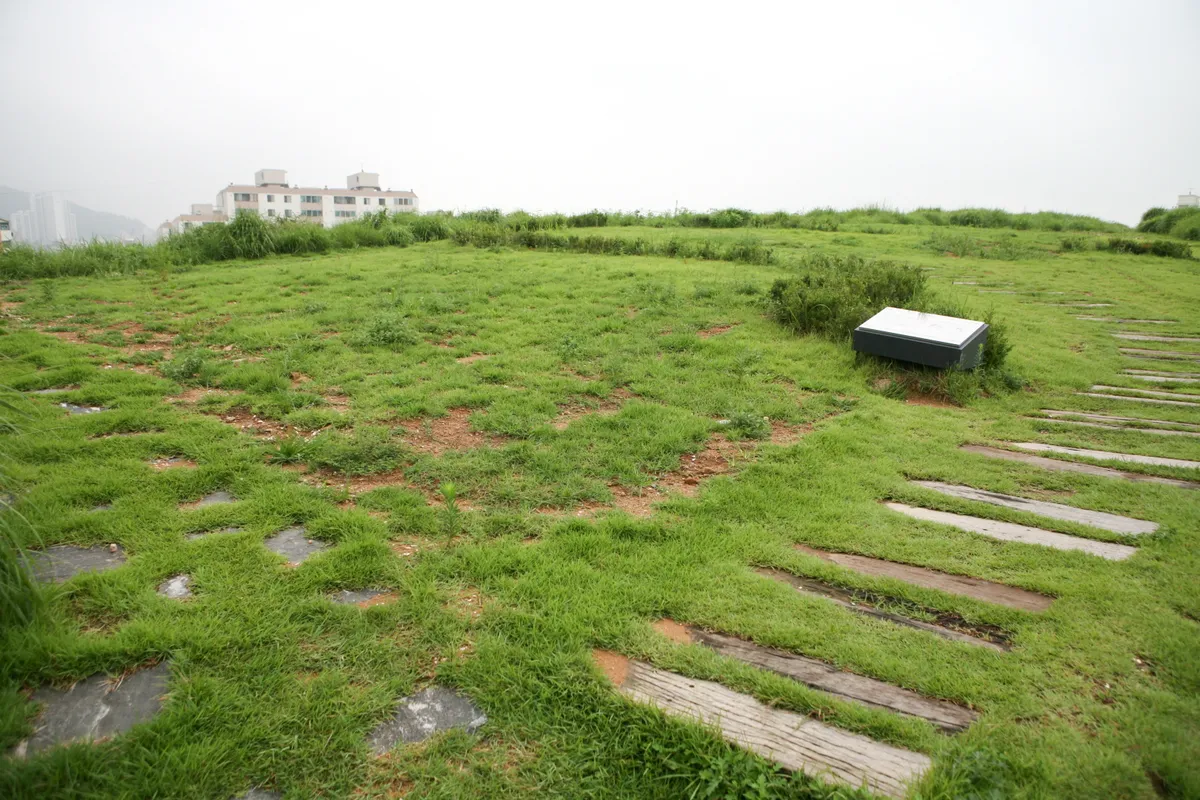
Daeseong-dong Tumuli, Gimhae
金海 大成洞 古墳群
경상남도 김해시
Basic information
- Designation
- Historic Site No.341
- Category
- 유적지
- Era
- 금관가야시대
- Designated year
- 1991
- Location
- 김해시, 경상남도— 경남 김해시 대성동 434번지
- Coordinates
- 35.237424, 128.873756
AI Docent
✨ AI-generatedWelcome to Daeseong-dong Tumuli, one of Korea's most fascinating burial sites! Imagine walking across a gentle hillside—just 300 meters long and 20 meters high—that once served as the final resting place for Gaya's ruling families from the 1st to 5th centuries. What makes this place extraordinary is the incredible variety of tombs archaeologists discovered here. You'll find pit tombs, wooden chamber tombs, and impressive stone chamber tombs with tunnel entrances, each telling a different story about how burial practices evolved over time. The wooden coffins are particularly special—they show a fascinating transition from log coffins to assembled wooden boards, influenced by cultures to the north. Combined with treasures like Chinese mirrors, earthenware, and ironware, these tombs reveal something remarkable: ancient Korea was deeply connected to China and Japan through trade and cultural exchange. This site offers a window into the sophisticated world of Gaya, one of Korea's ancient kingdoms, and how its people honored their ancestors.
⚠ This is an AI-generated retelling of the official description. For accuracy, refer to the official description below.
Description
It is located on a hilly area extending from east to west between Gimhae Construction Technical High School and Gimhae Public Stadium. The hill was a suitable location for an old tomb because it has length of about 300m, height of 20m, and gentle incline. The inclined area is currently cultivated, with the exception of a portion of the top of the hill. As a result of excavation and investigation by the museum of Gyeongseong University, many styles of tombs from the Gaya Era were found, including a pit tomb, a wooden chamber tomb, a stone chamber tomb with tunnel entrances, etc. A dolmen tomb of the ruling group from the 1st to the 5th century was also found. Old tombs from the 1st to 3rd century are clustered together within the field around the hill, and those from the 4th to 5th century, within the field around the hill. In this area, tombs from the Guya country from the Three Han Period to the Geumgwan Gaya Dynasty have been found. The wooden coffin tomb is a coffin made of assembled wooden boards, influenced by the Nangnang culture. The transition period during which a log coffin was used until the period when a wooden board coffin was adopted suggests that the time period was close to the 1st century. With ruins such as earthenware, ironware, trees, Chinese mirror, etc., excavated, these ruins carry important value showing the style of Korea’s ancient tombs and the structural changes of the wooden coffin tomb. It is also known as important material suggesting that cultural exchange took place among Korea, China, and Japan through Chinese mirrors and earthenware.
Location
지도를 불러오는 중…
Have you visited this place?
Log in and verify your visit on-site via GPS to record a stamp in My Journey. (QR verification coming later.)
Images: KOGL (khs.go.kr) · Data source: Korea Heritage Service Open API (khs.go.kr)