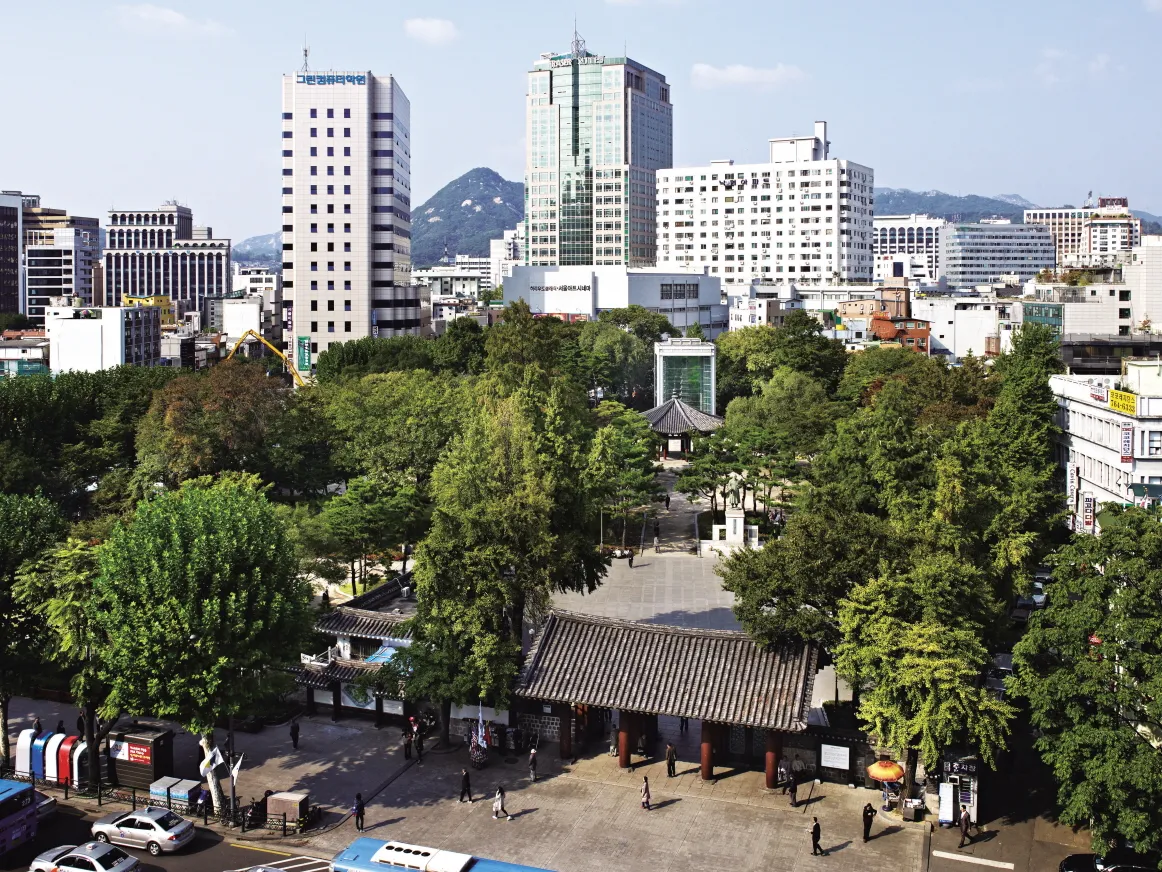
Tapgol Park, Seoul
서울 塔골公園
서울특별시 종로구
Basic information
- Designation
- Historic Site No.354
- Category
- 유적지
- Designated year
- 1991
- Location
- 종로구, 서울특별시— 서울 종로구 종로 99, 외 (종로2가)
- Coordinates
- 37.571175, 126.988315
AI Docent
Coming soonAn AI-generated, friendly retelling of this heritage site is available in Korean. An English version is on our roadmap — for now, please see the official description below.
Description
The first modern park was called Pagoda Park and was built at the site of Wongaksa Temple in Seoul. Initially, Wongaksa Temple was called Heungboksa Temple during the Goryeo Dynasty and was extended and renamed Wongaksa Temple during the early Joseon Dynasty. Due to the Joseon Dynasty’s fundamental policy of suppressing Buddhism, however, the temple was shut down during the reigns of King Yeonsangun and King Jungjong. In the late Joseon Dynasty, a Western-style park was developed at the site in accordance with the suggestion by a British man named Mr. Brown, but no written material exists as to the reasons for the establishment or when it was built. In the park are important cultural assets such as the Ten-story Stone Pagoda at the Wongaksa Temple Site (National Treasure No. 2) and the Stele for the Construction of Daewongaksa Temple at the Wongaksa Temple Site (Treasure No. 3). During the Japanese occupation, people made declarations for Korea’s independence at Palgakjeong, a pavilion of the park. In the park are other cultural heritage items, too, such as an embossed carving about the people and leaders making the declaration and a statue of Son Byeong-hui, a leader of the movement. On March 1, 1919, Korea’s independence was declared for the first time in the park during the Japanese occupation, developing into the March 1st Independence Movement across the nation. As such, this park holds very important historical meaning for Koreans.
Location
지도를 불러오는 중…
Have you visited this place?
Log in and verify your visit on-site via GPS to record a stamp in My Journey. (QR verification coming later.)
Images: KOGL (khs.go.kr) · Data source: Korea Heritage Service Open API (khs.go.kr)