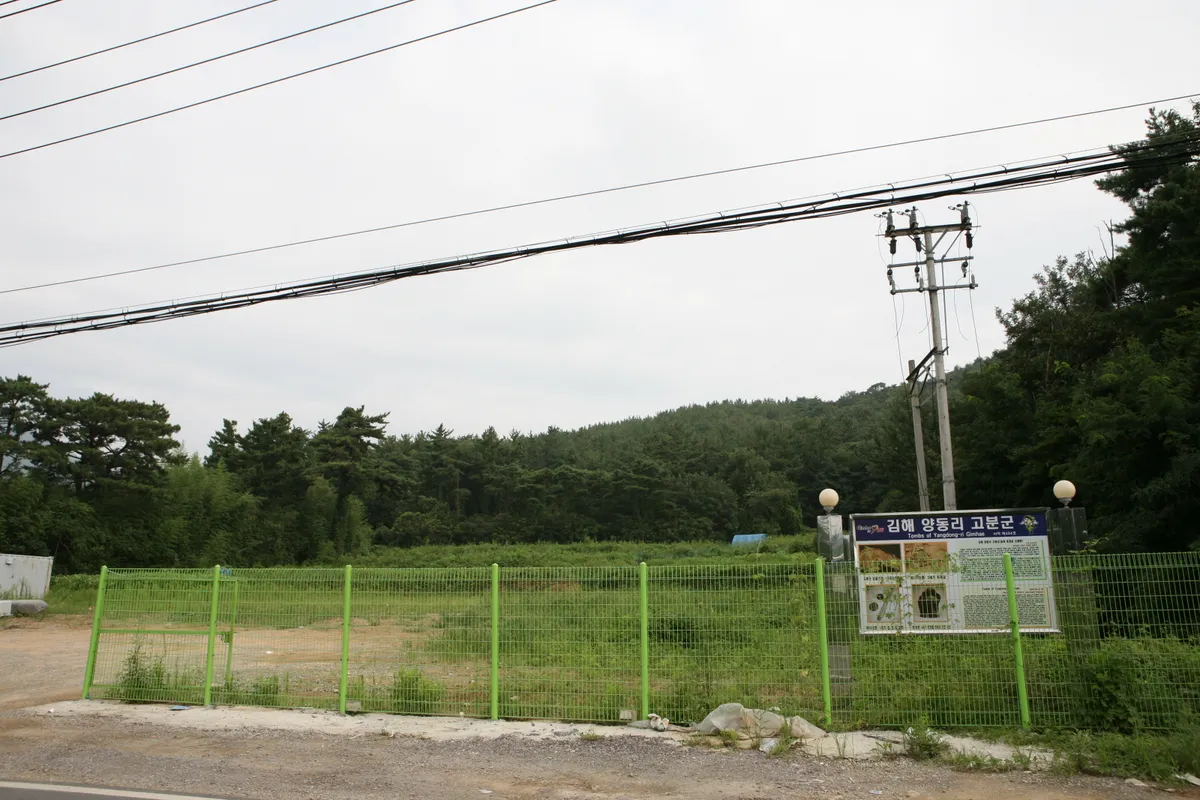
Ancient Tombs in Yangdong-ri, Gimhae
金海 良洞里 古墳群
경상남도 김해시
Basic information
- Designation
- Historic Site No.454
- Category
- 유적지
- Era
- 기원전 2세기대∼기원 5세기대
- Designated year
- 2004
- Location
- 김해시, 경상남도— 경남 김해시 주촌면 양동리 산3번지 등
- Coordinates
- 35.222553, 128.812279
AI Docent
Coming soonAn AI-generated, friendly retelling of this heritage site is available in Korean. An English version is on our roadmap — for now, please see the official description below.
Description
The ancient tombs in Yangdong-ri, Gimhae were formed from the 2nd century BC through the 5th century AD. Excavations have revealed various tomb types and many relics, making this an important site showing historical facts about the Gaya Kingdom from its formative years and onward through its growth and development. Known early on as one of the major groups of tombs in the Gimhae area, this site was first excavated in 1984 by the National Research Institute of Cultural Heritage and subsequently for four more times from 1990 to 1996 by Dong-Eui University Museum. The excavations revealed 548 tombs including wooden coffin tombs, wooden chamber tombs, stone-lined tombs, and jar coffin tombs as well as 5,100 relics including earthenware, bronze ware, and iron ware. The remains found provide important information on changes in tomb types and related dates, with the excavated relics not only revealing what the Gaya Kingdom was like at different stages but also supplementing the deficiencies of existing research. They are also important since they show the sophisticated international aspect of the Gaya culture. Thanks to the excavation findings, the nature of Gaya society and culture can be understood more clearly. They show that Guyaguk (or Bongaya) flourished thanks to its maritime activities, and that its iron culture had its heyday during the 2nd ~ 4th centuries when Gaya introduced foreign culture via the sea, since its maritime activities were at its peak. The relics indicate that iron played an important role in Gaya’s development, and that the loss of the iron market and drop in the value of iron were also a direct factor in Gaya’s demise. They also show that Gaya gradually declined under the force of the newly rising Silla and Baekje dynasties. Thus, the ancient tombs in Yangdong-ri, Gimhae and the remains and relics found at the site are very important since they suggest the real aspect of Gaya civilization at different stages of development, growth of Gaya society in the downstream region of Nakdonggang River, and nature of Gaya as a nation.
Location
지도를 불러오는 중…
Have you visited this place?
Log in and verify your visit on-site via GPS to record a stamp in My Journey. (QR verification coming later.)
Images: KOGL (khs.go.kr) · Data source: Korea Heritage Service Open API (khs.go.kr)