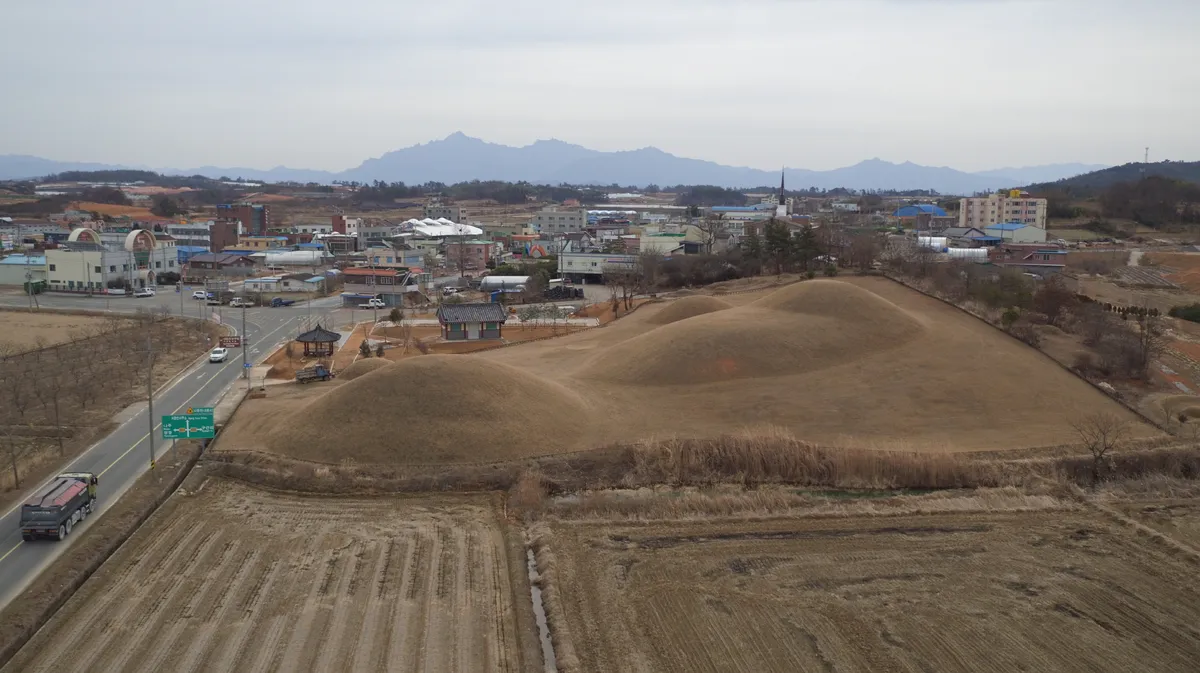
Sijong Tumuli, Yeongam
靈巖 始終 古墳群
전라남도 영암군
Basic information
- Designation
- Historic Site No.577
- Category
- 유적지
- Era
- 백제
- Designated year
- 2025
- Location
- 영암군, 전라남도— 전라남도 영암군 시종면 옥야리 159-2 내동리 579-1 일원
- Coordinates
- 34.896262, 126.589158Kakao address conversion
AI Docent
Coming soonAn AI-generated, friendly retelling of this heritage site is available in Korean. An English version is on our roadmap — for now, please see the official description below.
Description
Machine-translatedThis English description was machine-translated and may contain inaccuracies. Refer to the original Korean text for details.
The Yeongam Sijong Tumuli, constructed from the mid-to-late 5th century to the early 6th century, consist of the Okya-ri Jangdong Large-Scale Mound and Naedong-ri Twin Mounds located in Sijong-myeon, Yeongam County. These demonstrate the socio-cultural changes of Mahan indigenous society in the Yongsan River basin through mound construction and architectural techniques. Of the 49 ancient burial mounds distributed throughout Yeongam County, 28 are concentrated in Sijong-myeon, with two designated as historic sites. Sijong-myeon area, positioned at a strategic junction between the west coastal areas and inland regions, provided geographical advantages that enabled the indigenous forces of this region, which formed a small Mahan state, to develop unique culture and maintain independent power within relationships with central Baekje while integrating characteristics of the Yongsan River basin Mahan alongside influences from Baekje, Gaya, and China. The emergence of large tumuli in the Yongsan River basin began with the Okya-ri Jangdong Large-Scale Mound in the mid-5th century and continued through the Naedong-ri Twin Mounds, marking a transition from the traditional Mahan ceramic vessel burials to large-scale stone chamber and stone room burials. This reflects advancement in large mound construction techniques and reveals the level of contemporary civil engineering expertise. Excavated artifacts including gold-bronze crown ornaments, locally-prevalent pottery styles of the Yongsan River basin, and localized foreign imports such as cylindrical ceramics and zoomorphic clay figurines on mound exteriors demonstrate that the regional power maintained independence and cultural identity amid central Baekje governance and exchanges with neighboring states. Thus, the Yeongam Sijong Tumuli, which synthesizes traditional Mahan elements with those of Baekje, Gaya, China, and Wa to create a distinctive funerary system, is evaluated as a site of significant historical and academic value.
Location
지도를 불러오는 중…
Have you visited this place?
Log in and verify your visit on-site via GPS to record a stamp in My Journey. (QR verification coming later.)
Images: KOGL (khs.go.kr) · Data source: Korea Heritage Service Open API (khs.go.kr)