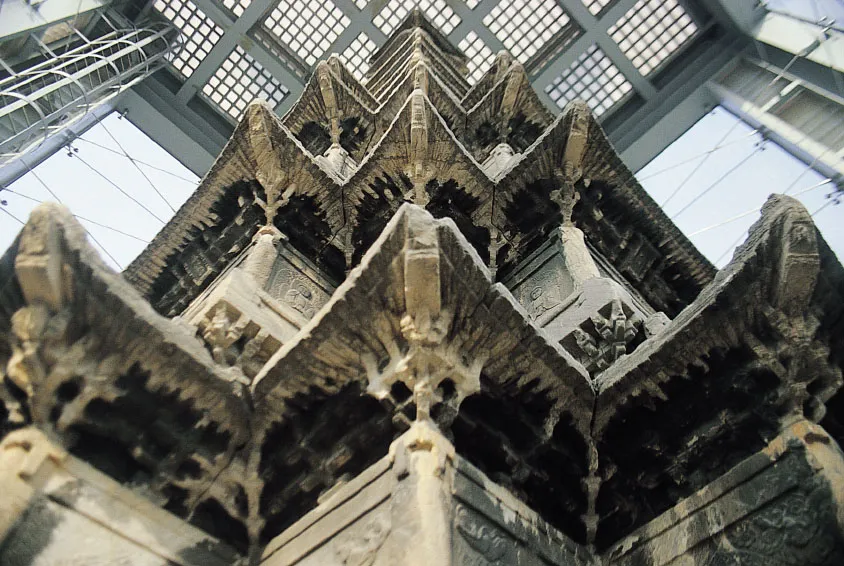
Ten-story Stone Pagoda at Wongaksa Temple Site, Seoul
서울 圓覺寺址 十層石塔
서울특별시 종로구
Basic information
- Designation
- National Treasure No.2
- Category
- Sites & Pagodas
- Era
- 조선시대 초기 15세기
- Designated year
- 1962
- Location
- 종로구, 서울특별시— 서울 종로구 종로 99 (종로2가) / (지번)서울 종로구 종로2가 38-2번지 탑골공원
- Coordinates
- 37.571546, 126.988208
AI Docent
Coming soonAn AI-generated, friendly retelling of this heritage site is available in Korean. An English version is on our roadmap — for now, please see the official description below.
Description
Wongaksa Temple whose precincts once housed this stone was established in 1465 at the current location of Tapgol Park in Downtown Seoul. The temple continued to thrive as a state institution even after the establishment of the Joseon Dynasty (1392-1910), which adopted Confucianism as its ideological foundation and suppressed Buddhism. It was in 1504 when Joseon was under the rule of Yeonsangun, a despotic king, that the temple was closed and its premises were turned into a gisaeng (female entertainer) house called Yeonbangwon. This 12-meter-tall marble pagoda is the only existing monument of its kind built during the Joseon Period, boasting of elaborately carved decorations that create wonderful aesthetic harmony with the grayish white surface of the marble. The pagoda consists of a three-tier base in polygonal shape -- decorated with elaborately carved images of various creatures such as dragon, lion, and lotus -- and the ten-story main body wherein the lower part of the three stories is polygonal in plain view just like the base and the upper part of the seven stories is in square form. Each story exhibits the appearance of a traditional Korean house in a detailed manner complete with roof, decorative support brackets, and columns. Compared with other Korean stone pagodas largely made of granite, this pagoda is unique since it is made of marble and due to its structure whose details are similar to those of the Ten-story Stone Pagoda of the Gyeongcheonsa Temple Site built during the Goryeo Period (918-1392). A record engraved on the top of the pagoda shows that it was set up in 1467. The pagoda is now regarded as a great masterpiece for its unique decorations wrought with excellent carving techniques.
Location
지도를 불러오는 중…
Have you visited this place?
Log in and verify your visit on-site via GPS to record a stamp in My Journey. (QR verification coming later.)
Images: KOGL (khs.go.kr) · Data source: Korea Heritage Service Open API (khs.go.kr)