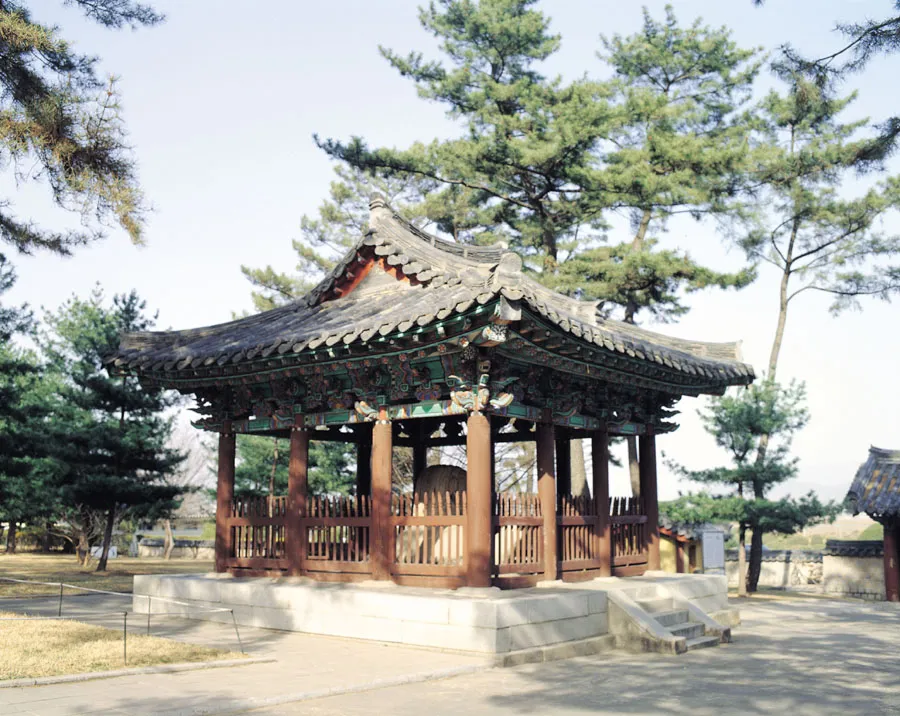
Stele of King Muyeol, Gyeongju
慶州 太宗武烈王陵碑
경상북도 경주시
Basic information
- Designation
- National Treasure No.25
- Category
- Sites & Pagodas
- Era
- 통일신라시대 초기
- Designated year
- 1962
- Location
- 경주시, 경상북도— 경북 경주시 서악동 844-1번지 / (도로명)경주시 대경로 4859
- Coordinates
- 35.825134, 129.188548
AI Docent
Coming soonAn AI-generated, friendly retelling of this heritage site is available in Korean. An English version is on our roadmap — for now, please see the official description below.
Description
This stele was erected in front of the Tomb of King Taejong Muyeol, the 29th ruler of Silla, in 661 (the 1st year of King Munmu’s reign). The inscription was calligraphed by Kim In-mun, who was the second son of the deceased king and a well-known master calligrapher. Steles built during the Unified Silla Period were influenced by the Tang Dynasty of China, and usually consisted of a tortoise-shaped pedestal and an ornamental capstone in the form of a dragon. The Stele for King Taejong Muyeol was the first monument to display such a style. At present, the whereabouts of the stele’s body is unknown, and only the tortoise-shaped pedestal and the capstone are housed in a pavilion. The tortoise of the pedestal extends its head high upward and its legs forward. There are large honeycomb-shaped hexagonal carvings on its back, and lotus designs are carved around the stele’s seat. The ornamental capstone is carved with three dragons on the left and three on the right, which coiled around each other to form a support for a “magic pearl.” The Chinese characters inscribed at the center of the front side clearly state for whom the stele was established. The tortoise-shaped pedestal and the capstone display realistic and vital expressions, suggesting the energetic spirit of the Silla people, who succeeded in unifying the three kingdoms. This stele is regarded as one of the finest masterpieces not only of Korea but also of Asia, thanks to the outstanding stone carving skills of that time.
Location
지도를 불러오는 중…
Have you visited this place?
Log in and verify your visit on-site via GPS to record a stamp in My Journey. (QR verification coming later.)
Images: KOGL (khs.go.kr) · Data source: Korea Heritage Service Open API (khs.go.kr)