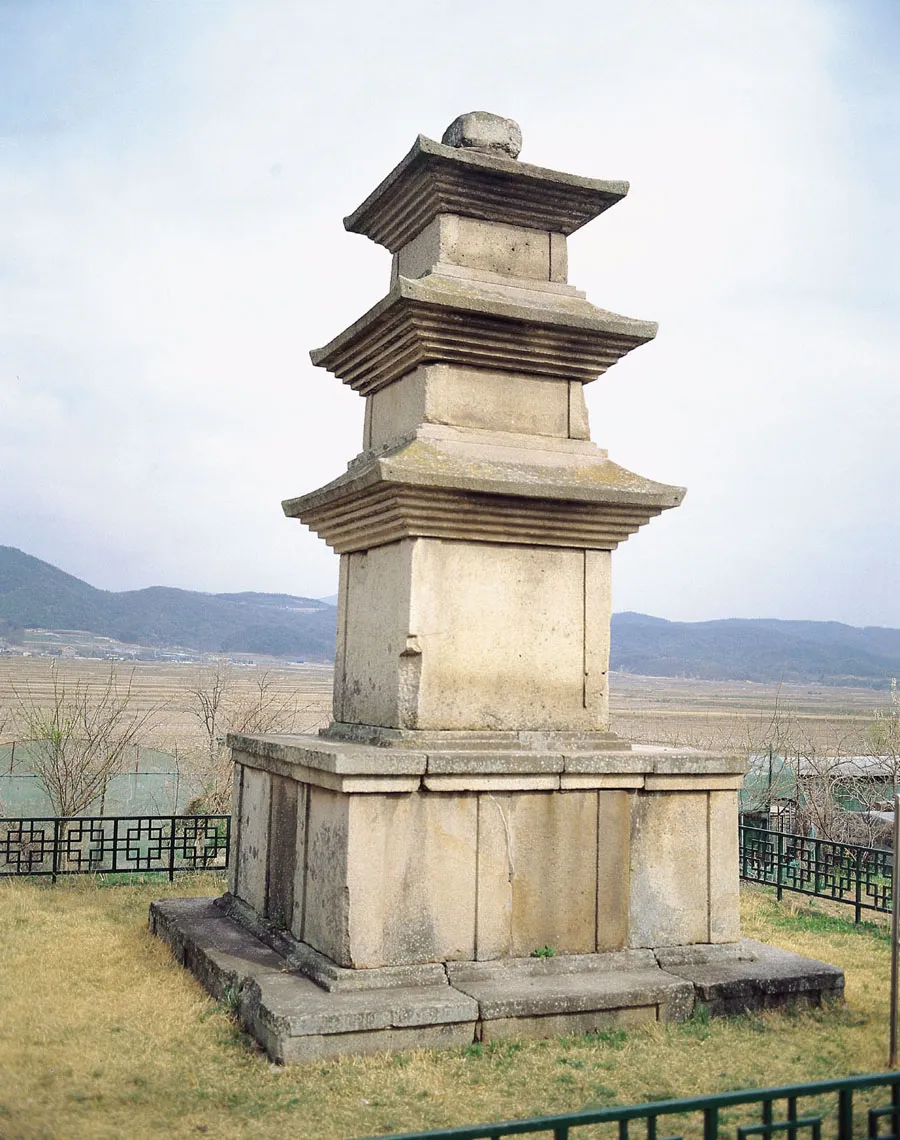
Three-story Stone Pagoda at Hwangboksa Temple Site, Gyeongju
慶州 皇福寺址 三層石塔
경상북도 경주시
Basic information
- Designation
- National Treasure No.37
- Category
- Sites & Pagodas
- Era
- 통일신라시대
- Designated year
- 1962
- Location
- 경주시, 경상북도— 경상북도 경주시 구황동 100
- Coordinates
- 35.832186, 129.242391
AI Docent
Coming soonAn AI-generated, friendly retelling of this heritage site is available in Korean. An English version is on our roadmap — for now, please see the official description below.
Description
After the death of King Sinmun of Unified Silla, his son King Hyoso built this pagoda in 692 to pray for the repose of his deceased father’s soul. After the death of King Hyoso, his successor King Seongdeok placed sarira and Buddhist statues for the two previous kings in the pagoda, and prayed for the prosperity and peace of his kingdom. It is a typical stone pagoda of the Silla Period, consisting of a three-story body erected on a two-story platform. It is smaller than the East and West Three-story Stone Pagodas at Gameunsa Temple Site (National Treasure No. 112) and the Three-story Stone Pagoda from Goseonsa Temple Site (National Treasure No. 38). The style of the platform is similar to that of the two aforementioned pagodas, but it shows signs of a change in the style of stone pagodas which saw the number of inner pillars of the first-story platform reduced from 3 to 2, while the main body and roof stones were each made of a single stone, rather than of several stones. The four corners of the roof stone are slightly raised to create a light appearance, and the roof supports consist of five layers. Only the base of the finial ornamentation remains on the top of the pagoda. With the dismantling and reconstruction of this pagoda in 1943, numerous Artifact were discovered in the second story roof stone, including gilt-bronze reliquaries and two gilt-bronze Buddhist statues. Some Chinese characters were carved on the inside of the lids of the reliquaries, providing information on the construction date and purpose of the pagoda. This pagoda exhibits the characteristic form of stone pagodas of the Unified Silla Period, and the changes in style that occurred in the early years of the kingdom.
Location
지도를 불러오는 중…
Have you visited this place?
Log in and verify your visit on-site via GPS to record a stamp in My Journey. (QR verification coming later.)
Images: KOGL (khs.go.kr) · Data source: Korea Heritage Service Open API (khs.go.kr)