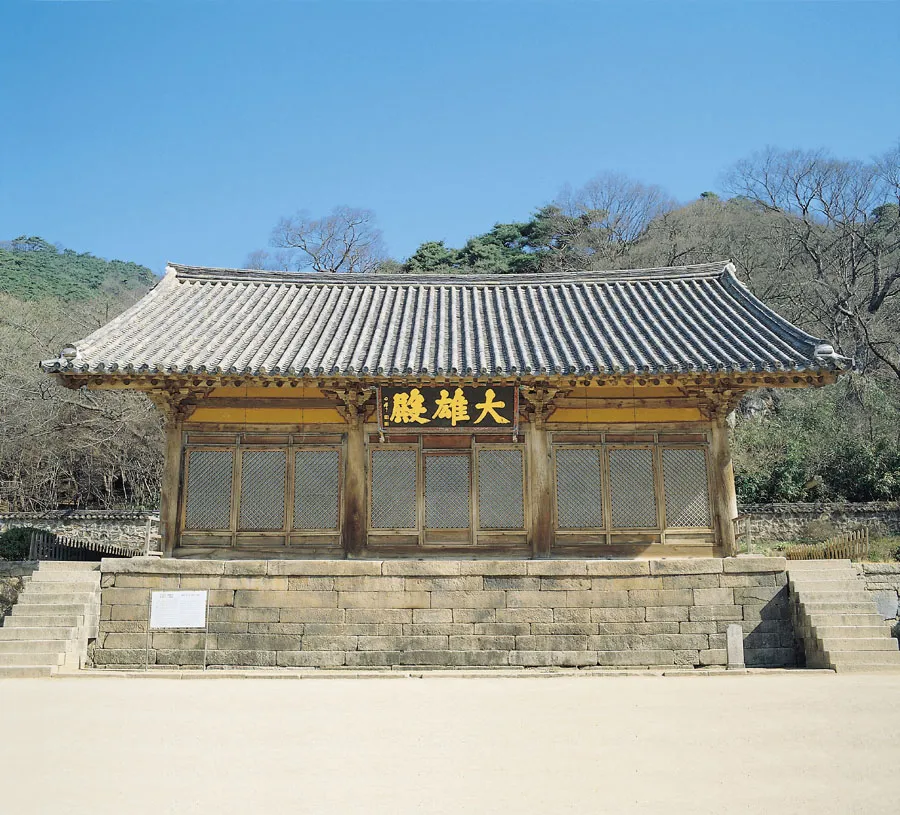
Daeungjeon Hall of Sudeoksa Temple, Yesan
禮山 修德寺 大雄殿
충청남도 예산군
Basic information
- Designation
- National Treasure No.49
- Category
- Architecture
- Era
- 고려 충렬왕 34년(1308)
- Designated year
- 1962
- Location
- 예산군, 충청남도— 충청남도 예산군 수덕사안길 79 (덕산면, 수덕사)
- Coordinates
- 36.663285, 126.622673
AI Docent
Coming soonAn AI-generated, friendly retelling of this heritage site is available in Korean. An English version is on our roadmap — for now, please see the official description below.
Description
Sudeoksa Temple is located on the foot of Deoksungsan Mountain in Yesan. According to a record discovered at the temple, it was established by Buddhist Monk Sungje during the late Baekje Period (18 BCE-660) and renovated by renowned Goryeo monk Naong (1320-1376). According to a different record, however, it was founded by Baekje Buddhist Monk Jimyeong in 599 and renovated by great Unified Silla monk Wonhyo (617~686). The temple’s Daeungjeon, was built in 1308 when Goryeo (918-1392) was under the rule of King Chungnyeol (1274~1308) to honor the historic Buddha Shakyamuni. It is one of Korea’s oldest existing buildings whose date of construction is clearly known. It is a building with three kan (a unit of measurement referring to the distance between two columns) on the front and back and four kan on the sides featuring gable roof, decorative brackets placed on top of the columns, triple three-panel lattice-window doors on the front, two windows on both sides at the rear, and plank door at the center. As a Goryeo building built under the influence of the architectural heritage of Baekje, the Daeungjeon Hall of Sudeoksa Temple is widely praised for its architectural beauty particularly the decorative elements on both sides. In addition to its fine structural merit and beauty, it is also a rare traditional architectural work whose date of construction is clearly recorded, making it a very important part of the Korean architectural heritage.
Location
지도를 불러오는 중…
Have you visited this place?
Log in and verify your visit on-site via GPS to record a stamp in My Journey. (QR verification coming later.)
Images: KOGL (khs.go.kr) · Data source: Korea Heritage Service Open API (khs.go.kr)