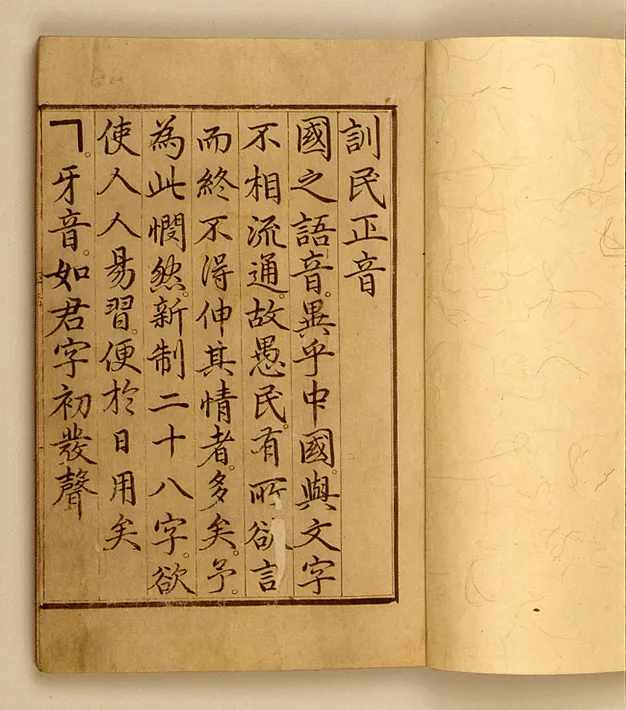
Hunminjeongeum (The Proper Sounds for the Instruction of the People)
訓民正音
서울특별시 성북구
Basic information
- Designation
- National Treasure No.70
- Category
- Books & Records
- Era
- 조선 세종 28년(1446)
- Designated year
- 1962
- Location
- 성북구, 서울특별시— 서울특별시 성북구 성북로 102-11 (성북동, 간송미술관)
- Coordinates
- 37.589116, 127.018215
AI Docent
Coming soonAn AI-generated, friendly retelling of this heritage site is available in Korean. An English version is on our roadmap — for now, please see the official description below.
Description
Hunminjeongeum is a commentary written in Chinese characters and published in 1446 by a group of renowned Jiphyeonjeon (Academy of Scholarly Worthies) scholars according to a royal edict issued by King Sejong (r. 1418-1450). The commentary has the same title as the original, Hunminjeongeum, given to the newly invented Korean writing system but different names, including The Explanatory Edition of the Correct Sounds for the Instruction of the People (Hunminjeongeum Haeryebon) and The Original Edition of the Correct Sounds for the Instruction of the People (Hunminjeongeum Wonbon). It is a single-volume xylographic book consisting of 33 chapters. In the book, the chapters are grouped into 3 parts wherein the first part contains the main text of Hunminjeongeum in 4 chapters printed on 7 pages, each containing 7 lines of text with 11 characters per line; the second part contains a commentary in 26 chapters on 51 pages, each containing 8 lines of text with 13 characters per line. The third part contains a 3-chapter introduction of the writing system written by Jeong In-ji (1396-1478) and which ends with a date, suggesting that the Korean writing system was promulgated in 1446. According to The Veritable Records of King Sejong (Sejong Sillok), the Korean alphabet called Hunminjeongeum was invented in 1443 by King Sejong himself and proclaimed in 1446. The commentary and Jeong In-ji’s introduction as contained in this book provide information on the scholar-statesman’s active participation in the creation of the alphabet and the basic principles used for it.
Location
지도를 불러오는 중…
Have you visited this place?
Log in and verify your visit on-site via GPS to record a stamp in My Journey. (QR verification coming later.)
Images: KOGL (khs.go.kr) · Data source: Korea Heritage Service Open API (khs.go.kr)