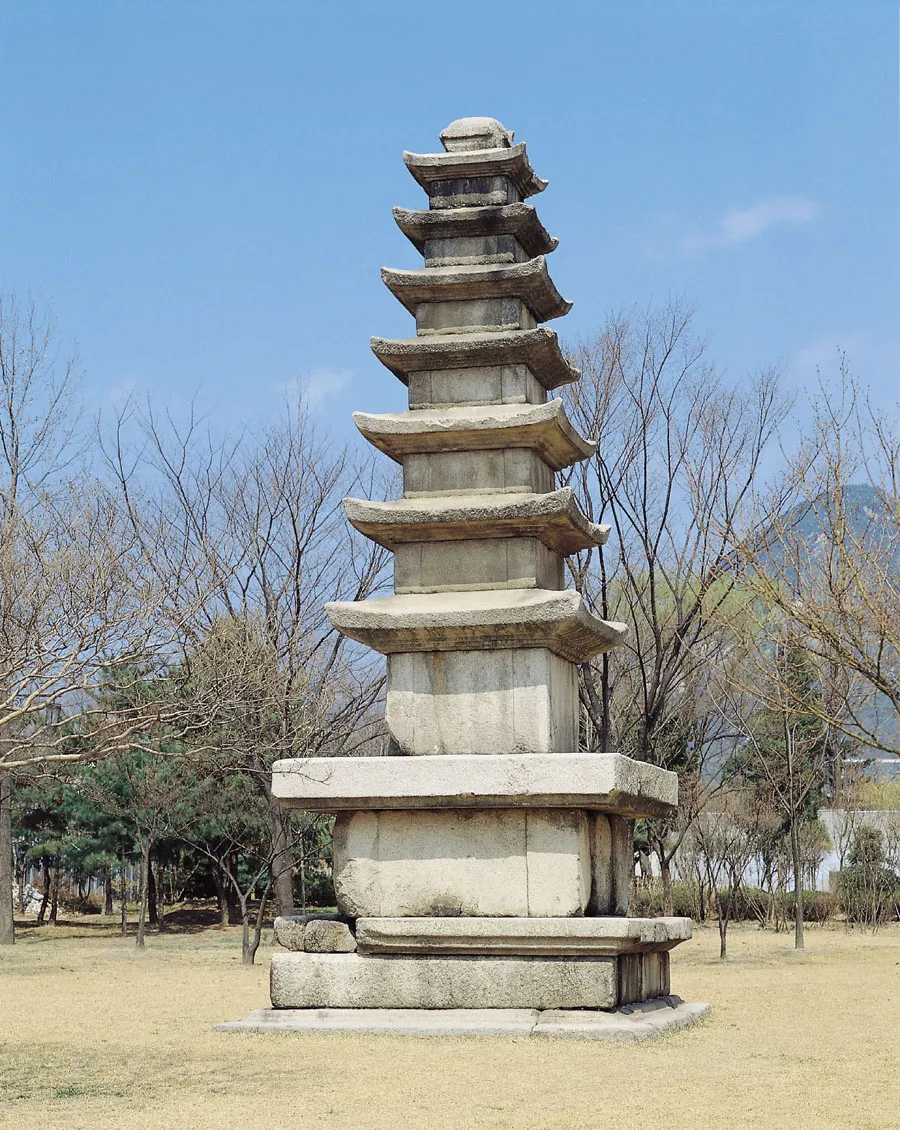
Seven-story Stone Pagoda from Namgyewon Temple Site, Gaeseong
開城 南溪院址 七層石塔
서울특별시 용산구
Basic information
- Designation
- National Treasure No.100
- Category
- Sites & Pagodas
- Era
- 고려시대
- Designated year
- 1962
- Location
- 용산구, 서울특별시— 서울 용산구 서빙고로 137, 국립중앙박물관 (용산동6가)
- Coordinates
- 37.522300, 126.980984
AI Docent
Coming soonAn AI-generated, friendly retelling of this heritage site is available in Korean. An English version is on our roadmap — for now, please see the official description below.
Description
When this stone pagoda was moved to Gyeongbokgung Palace in 1915 from the site of a ruined temple -- which had been wrongly known by the name Gaeguksa -- located near Gaeseong, Gyeonggi-do, it had only its main seven-story structure. It was not until many years later when a more extensive survey was conducted on the temple site that historians discovered the pagoda’s base along with the temple’s correct name, which is Namgyewon. The newly excavated double-tier base was moved to the location of its main structure at the palace precincts; finally, both were moved to and restored at the current location in the National Museum of Korea. The pagoda’s overall structure -- a double-tier base supporting the main body of seven stories -- is very similar to the typical style of Silla (57 BC – 935) pagodas; a closer look at its details reveals notable differences, however. First, the lower base of this pagoda is conspicuously taller than ordinary Silla pagodas, whereas the upper base is slightly lower. The body and roof of each story are made by carving a single stone block, and each body has a pair of corner columns carved in low relief. Each roof is comparatively thick, with corners turned up rather dramatically -- showing the influence of the Goryeo pagodas -- and three-step cornices under the eaves. The finial is heavily damaged, leaving only part of a “dew basin” (Noban) and an “overturned bowl” (Bokbal) carved with a single stone block. An imposing ambience created by a lofty structure -- carved using the techniques refined by Silla artisans -- and some details showing the influence of Goryeo masonry suggest that the pagoda was originally built before the mid-Goryeo period (918-1392). The 1915 restoration work led to the discovery of seven scrolls -- on which the Transcription of Saddharmapundarika Sutra (The Lotus Sutra) in Silver on Indigo Paper -- which were enshrined in the pagoda when it was renovated in 1283 when Goryeo was under the rule of King Chungnyeol (r. 1274-1308).
Location
지도를 불러오는 중…
Have you visited this place?
Log in and verify your visit on-site via GPS to record a stamp in My Journey. (QR verification coming later.)
Images: KOGL (khs.go.kr) · Data source: Korea Heritage Service Open API (khs.go.kr)