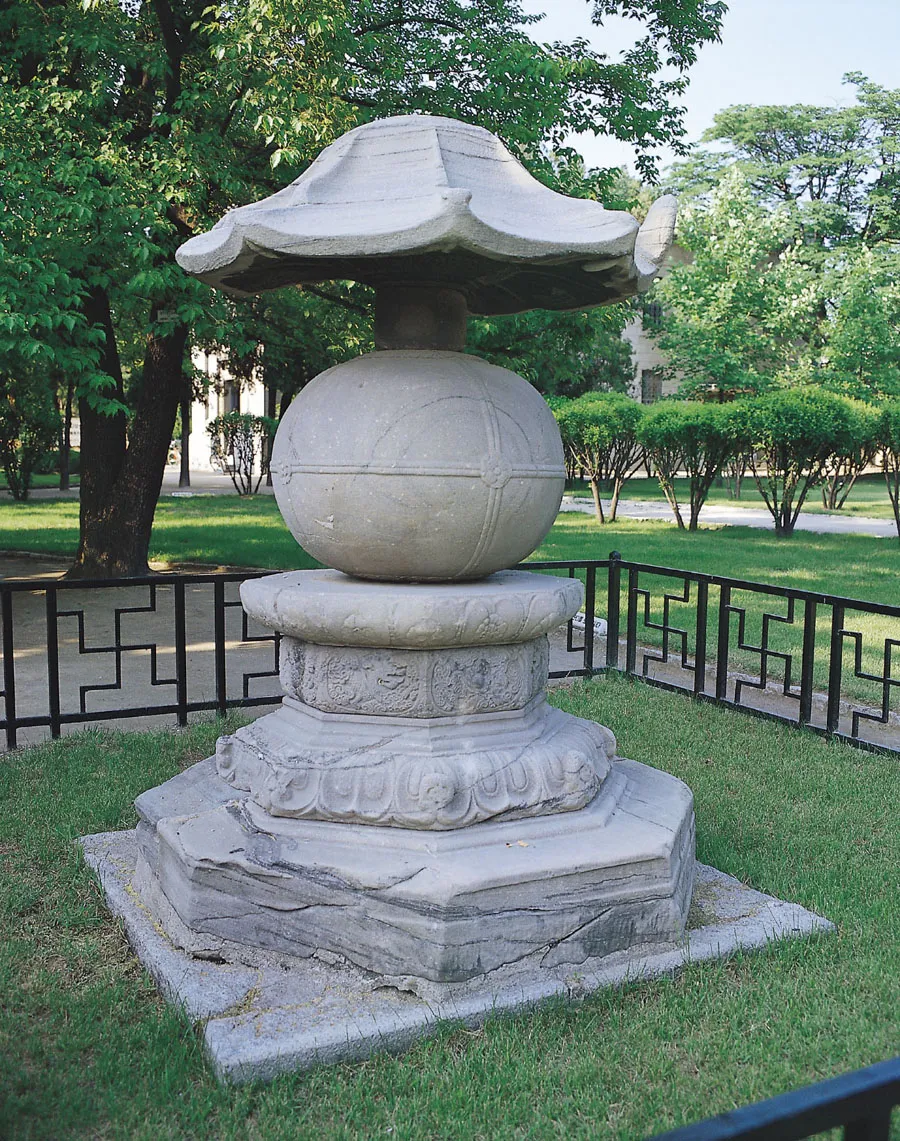
Stupa of State Preceptor Hongbeop from Jeongtosa Temple Site, Chungju
忠州 淨土寺址 弘法國師塔
서울특별시 용산구
Basic information
- Designation
- National Treasure No.102
- Category
- Sites & Pagodas
- Era
- 고려 현종 8년(1017)
- Designated year
- 1962
- Location
- 용산구, 서울특별시— 서울 용산구 서빙고로 137, 국립중앙박물관 (용산동6가)
- Coordinates
- 37.523423, 126.981360
AI Docent
Coming soonAn AI-generated, friendly retelling of this heritage site is available in Korean. An English version is on our roadmap — for now, please see the official description below.
Description
This reliquary monument, set up to honor eminent Goryeo monk and State Preceptor Hongbeop, had originally been located at a Buddhist temple called Jeongtosa in Jungwon-gun (today’s Chungju), Chungcheongbuk-do but was moved to Gyeongbokgung Palace in 1915 and, finally, to its current location in the National Museum of Korea in Seoul. Hongbeop was an eminent spiritual leader for the Korean Buddhists in the 10th century, introducing them to Seon (or Zen) Buddhism that he had studied in Tang. He was given the honorable title “State Preceptor” (Guksa) after “Great Seon Master” (Seonsa) when Goryeo was under the reign of King Seongjong (981-997). The stupa features a foundation consisting of a square slab supporting an octagonal base and a three-tier pedestal whose lower pedestal is shaped like a down-turned lotus blossom; the octagonal middle pedestal is elaborately carved with dragons flying between clouds, and the upper pedestal is shaped like an upturned lotus blossom. On the pedestal is a spherical stone carved with ropes tying the stone sphere crisscross with floral motifs placed on the spots where the ropes intersect. The roofstone is comparatively simple, with no significant ornamentation except the “corner flowers,” most of which are now missing. Under the roofstone are heavenly maids carved in relief. As a work built in 1017 when Goryeo was under the rule of King Hyeonjong (r. 1010-1031), the stupa had introduced some new elements even as it also maintained the style of Silla stupas characterized by an octagonal structure. With fine balance and harmony between new and old techniques and elements and use of a spherical stone for its main feature, the monument is widely considered one of the most valuable stupas erected during the Goryeo period.
Location
지도를 불러오는 중…
Have you visited this place?
Log in and verify your visit on-site via GPS to record a stamp in My Journey. (QR verification coming later.)
Images: KOGL (khs.go.kr) · Data source: Korea Heritage Service Open API (khs.go.kr)