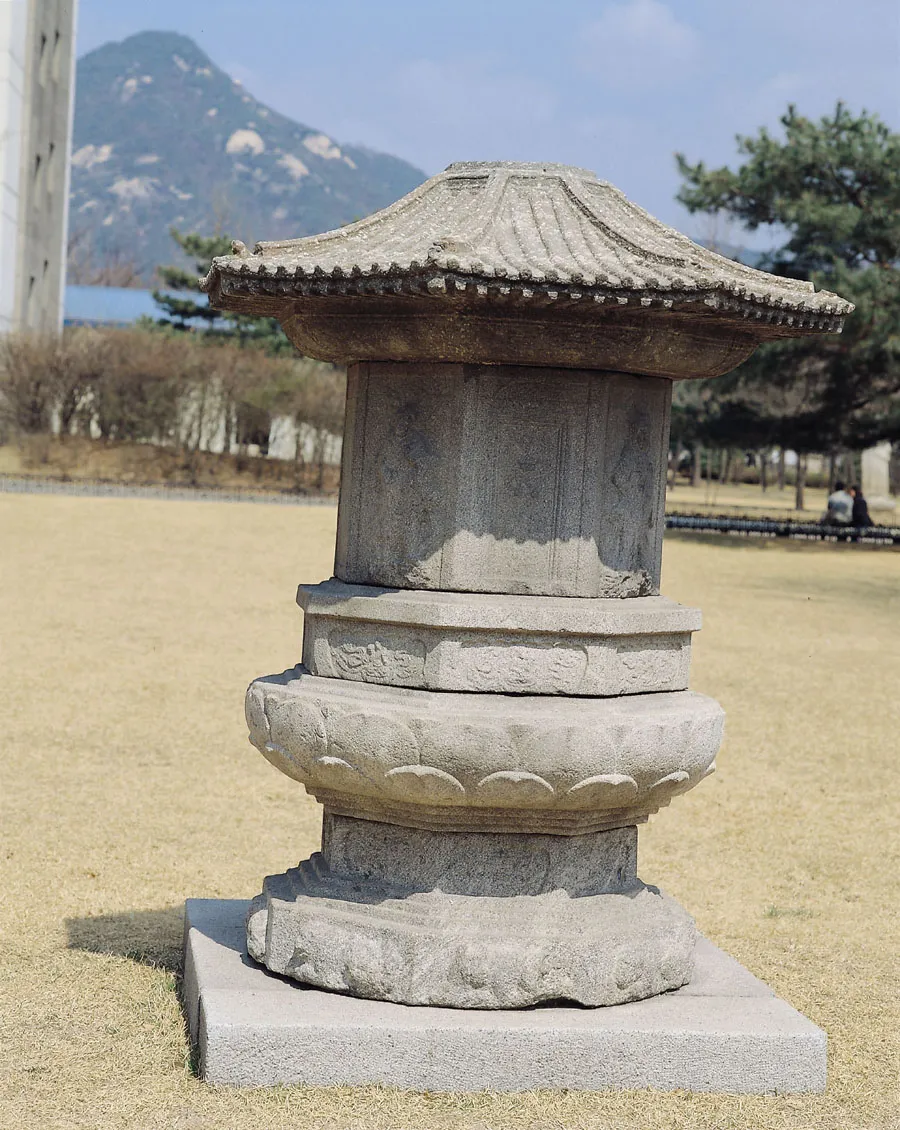
Stupa of Buddhist Monk Yeomgeo from Heungbeopsa Temple Site, Wonju
傳 原州 興法寺址 廉居和尙塔
서울특별시 용산구
Basic information
- Designation
- National Treasure No.104
- Category
- Sites & Pagodas
- Era
- 통일신라 문성왕 6년(844년)
- Designated year
- 1962
- Location
- 용산구, 서울특별시— 서울 용산구 서빙고로 137, 국립중앙박물관 (용산동6가)
- Coordinates
- 37.523514, 126.980619
AI Docent
Coming soonAn AI-generated, friendly retelling of this heritage site is available in Korean. An English version is on our roadmap — for now, please see the official description below.
Description
This sarira stupa was built to honor the life and achievement of Priest Yeomgeo (?-844), a renowned Unified Silla monk who learned Seon (Chan, or Zen) Buddhism from Seon Master Doui (fl. late 8th and early 9th c.), who devoted himself to the propagation of new Buddhist ideology and practice. He had Chejing (804-880) as his head pupil and helped him lay a firm foundation for the development of Seon Buddhism. The stupa is generally presumed to have originally been at the Heungbeopsa Temple site in Gangwon-do. It was moved to Seoul where it was transferred to several different locations, including Tapgol Park and Gyeongbokgung Palace in downtown Seoul, until finding the current location in the National Museum of Korea. The remaining structure of the stupa is consisted of three parts, a three-tier base, octagonal main body, and roofstone which is also octagonal. The base is formed by combining three stones decorated with elegant carvings where the lower stone displays lions carved in relief, the middle stone incense burners carved in “elephant eyes”, and the upper stone, which is subdivided into two tiers, two bands of lotus petals for the lower tier and another set of “elephant eyes” containing various decorative carvings. The main body enshrining the priest’s relics (sarira) has eight faces each to contain either a door or one of the Four Guardian Kings, all elaborately carved in low relief. The roofstone is equally elaborately carved to present the tiled roof of the wooden buildings of the period complete with detailed furrows and ridges as well as the decorative roof-end tiles and rafters under the eaves. The finial is now missing. An inscription engraved on a gilt-bronze plate discovered during a rebuilding work revealed that the stupa was built in 844 when Unified Silla was under the rule of King Munseong (r. 839-857). The monument is highly regarded not just because it is known as the oldest remaining sarira stupa in Korea but also its elegant structure elaborately carved by masterful skills, setting a fine example for other stupas to follow.
Location
지도를 불러오는 중…
Have you visited this place?
Log in and verify your visit on-site via GPS to record a stamp in My Journey. (QR verification coming later.)
Images: KOGL (khs.go.kr) · Data source: Korea Heritage Service Open API (khs.go.kr)