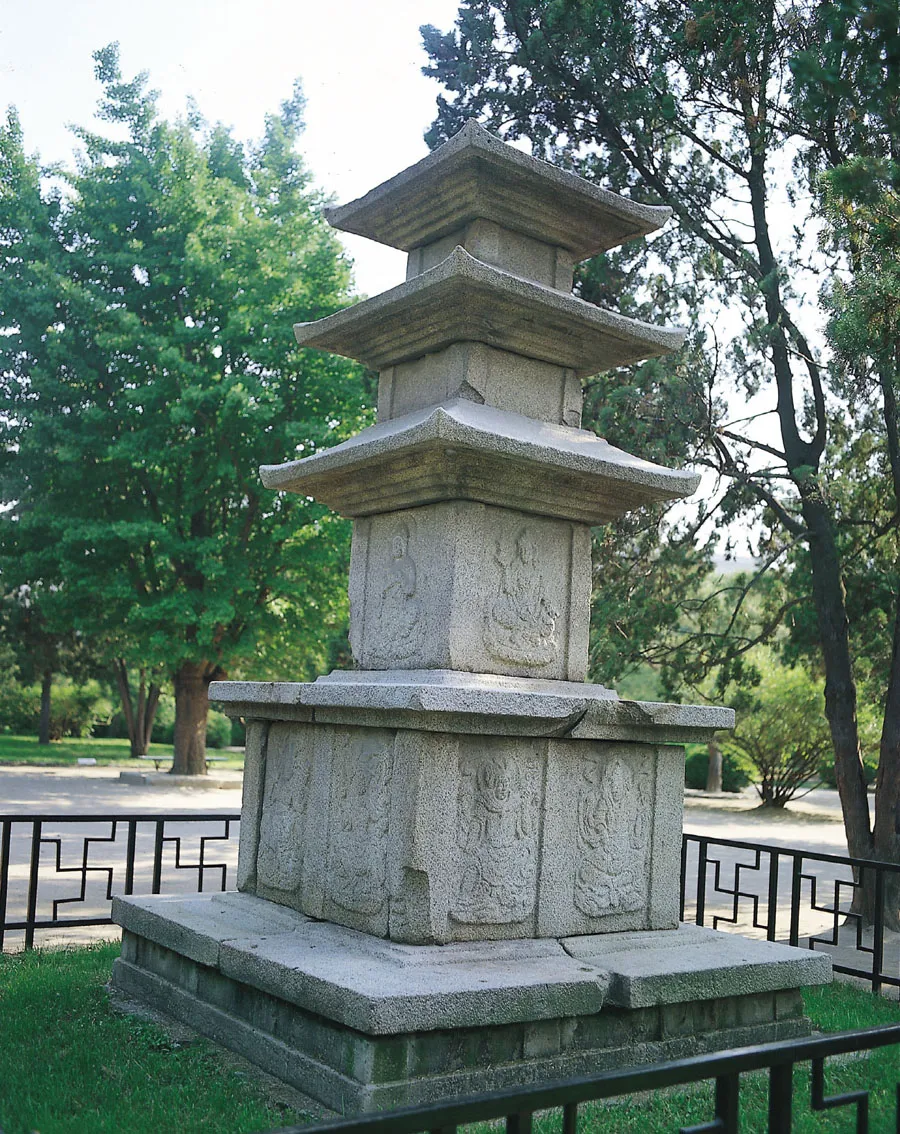
Three-story Stone Pagoda in Beomhak-ri, Sancheong
山淸 泛鶴里 三層石塔
경상남도 진주시
Basic information
- Designation
- National Treasure No.105
- Category
- Sites & Pagodas
- Era
- 통일신라시대 9세기
- Designated year
- 1962
- Location
- 진주시, 경상남도— 경상남도 진주시 남강로 626 (본성동, 진주성) 국립진주박물관 야외전시장
- Coordinates
- 35.189463, 128.076668
AI Docent
Coming soonAn AI-generated, friendly retelling of this heritage site is available in Korean. An English version is on our roadmap — for now, please see the official description below.
Description
Originally a ruined pile of stones located at the site of an old temple named Beomheosa in Sancheong, Gyeongsangnam-do, this stone pagoda was purchased by a Japanese antique dealer in 1941 and rebuilt at a factory yard in Daegu. The pagoda was moved to Gyeongbokgung Palace in Seoul in 1947 and then to the Jinju National Museum where it stands today. The pagoda exhibits the typical appearance of the Korean three-story stone pagodas with the double-tier base on which a three-story structure is erected. The foundation has lost the original structure due to the cement used to reinforce the structure at the time of rebuilding. Each tier of the base has four corner columns, two (lower tier) and one (upper tier) central columns, all carved in relief. There are the Eight Guardian Deities, two on each of the four sides, carved in relief and, on the first-story body, four bodhisattvas, one on each side. Each of the three roofstones features four-tier cornice, thin and gentle slopes, and delightfully upturned corners. The pagoda is also dubbed “decorative pagoda” largely because the elaborate carvings of Palbujungsang, i.e. the eight guardian deities of Buddhist law around the upper tier of the base and the first-story body. Some experts point out that the rather excessive decorative carvings rid the pagoda of the majestic simple appearance that characterizes the pagodas of its kind, but believe that it is a fine example of the stone pagodas of late Unified Silla.
Location
지도를 불러오는 중…
Have you visited this place?
Log in and verify your visit on-site via GPS to record a stamp in My Journey. (QR verification coming later.)
Images: KOGL (khs.go.kr) · Data source: Korea Heritage Service Open API (khs.go.kr)