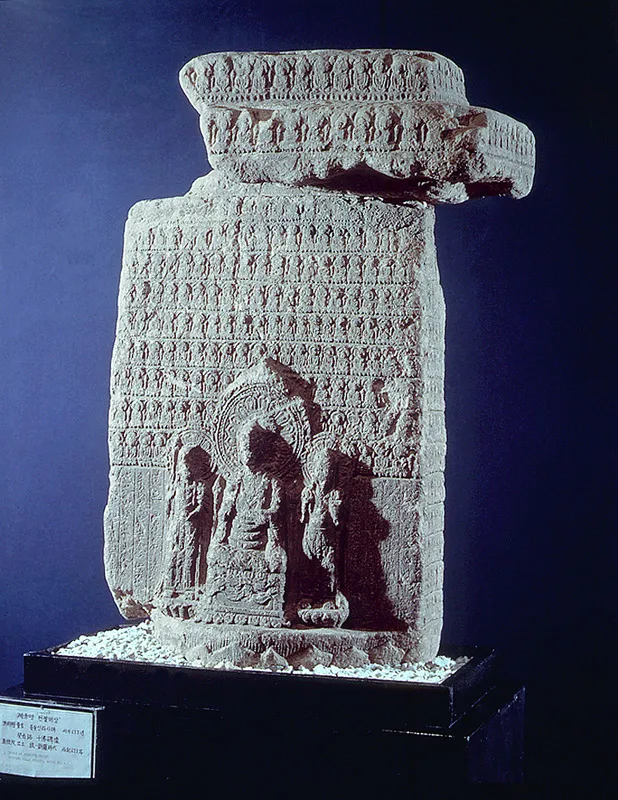
Buddhist Stele of Buddha Triad and a Thousand Buddhas with Inscription of "Gyeyu Year"
癸酉銘三尊千佛碑像
충청북도 청주시
Basic information
- Designation
- National Treasure No.108
- Category
- Sculpture
- Era
- 통일신라시대
- Designated year
- 1962
- Location
- 청주시, 충청북도— 충청북도 청주시 상당구 명암로 143 (명암동, 국립청주박물관)
- Coordinates
- 36.649700, 127.507300Museum-based location
AI Docent
Coming soonAn AI-generated, friendly retelling of this heritage site is available in Korean. An English version is on our roadmap — for now, please see the official description below.
Description
Discovered at a Buddhist hermitage called Seogwangam located nearby Jochiwon, Yeongi-gun of Chungcheongnam-do, this monumental stele is filled with Buddhist images and inscriptions carved in relief. There is a Buddha triad carved prominently on the lower part of the front face with its sides filled with inscriptions while the rest of the front face, the rear and both sides are covered with carvings of tiny Buddhist images. The Buddha triad placed on a semicircular base decorated with lotus design features a principal Buddha seated on a cubic pedestal with his two acolytes on his both sides. The Buddha is heavily damaged, losing most of its details except for the robe which covers his both shoulders and is drawn down to cover most of the pedestal. The two bodhisattvas attending him are also heavily damaged, but their inner robes crossed over the knee reveal that the monument was made during the Three Kingdoms Period (57 BCE – 668). The mandorlas around the heads of the three deities ornamented with lotus and flame designs are in a comparatively good condition. There is above the main part a capstone half of which is broken off but the remaining part is equally covered with carvings of miniature Buddha images arranged in a regular manner to form a lattice pattern, suggesting that the triad is originally intended to be guarded by a thousand Buddhas. All of these tiny Buddhas have their own mandorlas around the head and are in robes covering both shoulders. The inscriptions engraved on both sides of the triad propose that the monument was set up in 673 by people of Baekje who were longing for the restoration of their lost country and praying for the peaceful rest of their ancestors.
Location
지도를 불러오는 중…
Have you visited this place?
Log in and verify your visit on-site via GPS to record a stamp in My Journey. (QR verification coming later.)
Images: KOGL (khs.go.kr) · Data source: Korea Heritage Service Open API (khs.go.kr)