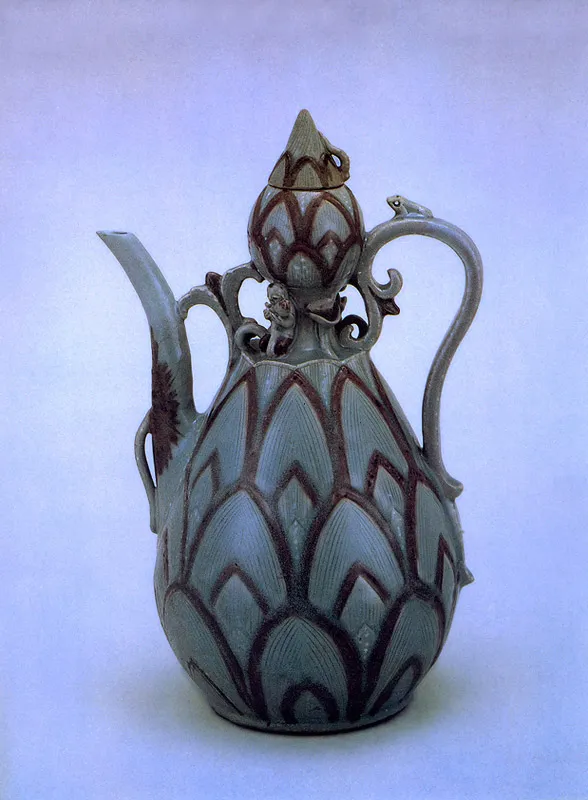
Celadon Gourd-shaped Ewer with Lotus Design in Underglaze Copper
靑磁 銅畵蓮花文 瓢形 注子
서울특별시 용산구
Basic information
- Designation
- National Treasure No.133
- Category
- Craft
- Era
- 고려시대
- Designated year
- 1970
- Location
- 용산구, 서울특별시— 서울특별시 용산구 이태원로55길 60-16 (한남동, 삼성박물관 리움)
- Coordinates
- 37.536528, 126.996187
AI Docent
Coming soonAn AI-generated, friendly retelling of this heritage site is available in Korean. An English version is on our roadmap — for now, please see the official description below.
Description
The ewer (height: 33.2cm bottom diameter: 11.4cm), which dates back to the mid-Goryeo Period (877-1394), has a gourd-shaped body whose surface is covered with lotus leaves. Its lid looks like a flower bud. Its neck is adorned with lotus leaves as well as the figure of a child embracing a lotus bud. Its handle looks like a slightly bent scrolling vine with the figure of a frog seated at the top. Its spout looks like a rolled lotus leaf. The technique of adorning blue celadon with cinnabar was used in the early 12th Century, but artworks ostentatiously adorned with cinnabar-made patterns were thought to have appeared for the first time only after the 13th Century. This piece, showing the cinnabar-adorned edges and veins of lotus leaves, was unearthed from the tomb of Choe Hang in Ganghwa, Gyeonggi-do. The piece was presumed to date back to the reign of King Gojong (r.1213-1259) of the Goryeo Dynasty. Its splendid cinnabar color makes it a precious material for those studying Goryeo Celadon.
Location
지도를 불러오는 중…
Have you visited this place?
Log in and verify your visit on-site via GPS to record a stamp in My Journey. (QR verification coming later.)
Images: KOGL (khs.go.kr) · Data source: Korea Heritage Service Open API (khs.go.kr)