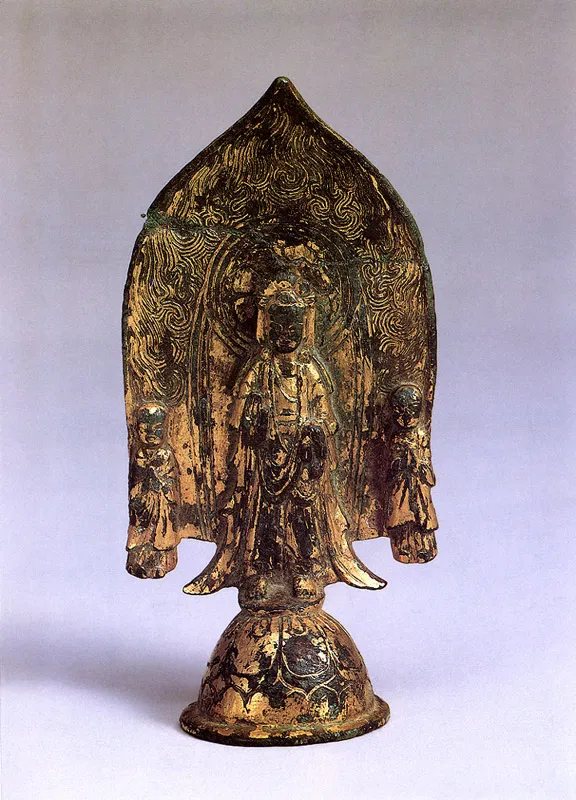
Gilt-bronze Standing Bodhisattva Triad
金銅菩薩三尊立像
서울특별시 용산구
Basic information
- Designation
- National Treasure No.134
- Category
- Sculpture
- Era
- 백제시대
- Designated year
- 1970
- Location
- 용산구, 서울특별시— 서울특별시 용산구 서빙고로 137 (용산동6가, 국립중앙박물관)
- Coordinates
- 37.536528, 126.996187
AI Docent
Coming soonAn AI-generated, friendly retelling of this heritage site is available in Korean. An English version is on our roadmap — for now, please see the official description below.
Description
This image is said to have been found in Chuncheon, Gangwon-do, with a mandorla (Buddhist halo of light) laid behind the triad. It is a unique object with the triad, a mandorla, and a pedestal in one piece. The round-faced main Bodhisattva in the center wears a crown. It shows thin underwear worn diagonally. The two parts of the thick outer robe cross each other in the front, and then spread out at the bottom like bird feathers. The lower part of the robe extends down to the ankle. Robe wrinkles are portrayed in lines. The right hand is raised to the shoulder, with the palm facing outward. The fingers of the left hand are pointing downward, with the ring finger and the little finger bent inward. The two attendant Arhats stand with their hands clasped, wearing thick robes. The mandorla behind the triad is shaped like a boat with a conspicuous-looking edge, with three lines forming the head and body mandorla. The head mandorla is inscribed with lotus flower patterns. Exquisite flame patterns are shown outside the head and body mandorla. The pedestal on which the main Bodhisattva stands displays large-sized lotus flower patterns in double lines. The use of such style in the pedestal is similar to that of the Gilt-bronze Standing Sakyamuni Buddha Triad with Inscription of “Jeong Ji-won” (Treasure No. 196) and Gilt-bronze Pensive Maitreya Bodhisattva (National Treasure No. 83) unearthed from Busosan Mountain in Buyeo. Thus, the image was presumed to date back to the Baekje Period, but it is more exquisitely portrayed than the former. The parts of the robe crossing each other like the letter “X,” the bottom of the robe spreading outward like bird feathers, the fingers of the left hand bent inward, etc., follow a typical style of Buddha images made during the Three-Kingdoms Period (circa 57BC-668AD). The two Arhats standing next to the main Bodhisattva represent the first practice ever displayed by ancient relics found on the Korean Peninsula. Thus, the piece is considered to be a unique and precious object.
Location
지도를 불러오는 중…
Have you visited this place?
Log in and verify your visit on-site via GPS to record a stamp in My Journey. (QR verification coming later.)
Images: KOGL (khs.go.kr) · Data source: Korea Heritage Service Open API (khs.go.kr)