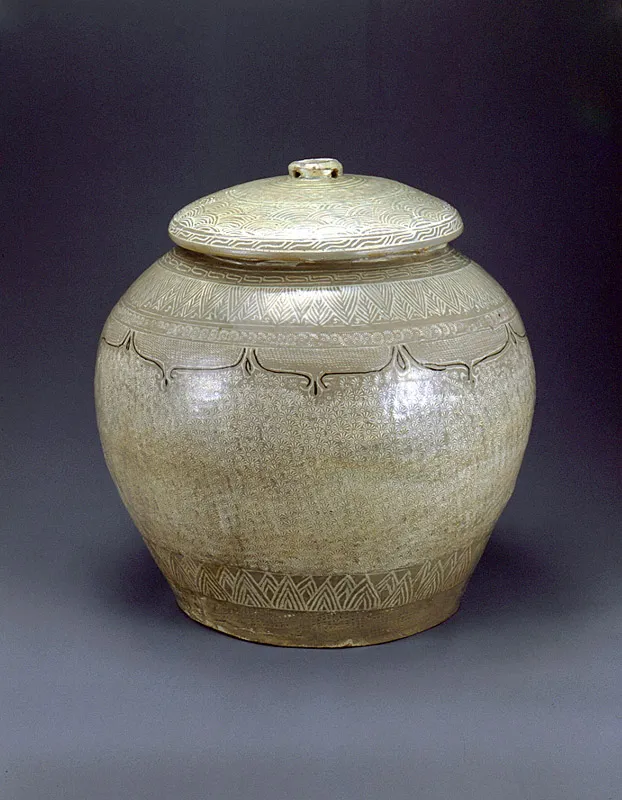
Buncheong Placenta Jars with Stamped Chrysanthemum Design
粉靑沙器 印花菊花文 胎壺
서울특별시 성북구
Basic information
- Designation
- National Treasure No.177
- Category
- Craft
- Era
- 조선시대(15세기)
- Designated year
- 1974
- Location
- 성북구, 서울특별시— 서울 성북구 안암로 145, 고려대학교박물관 (안암동5가,고려대학교안암캠퍼스(인문사회계))
- Coordinates
- 37.589600, 127.029900Museum-based location
AI Docent
Coming soonAn AI-generated, friendly retelling of this heritage site is available in Korean. An English version is on our roadmap — for now, please see the official description below.
Description
These two lidded jars come in a pair, with the smaller jar designed to fit into the larger one. The smaller one has a height of 26.5cm, mouth diameter of 9cm and base diameter of 9.5cm. The bigger one has a height of 42.8cm in height, mouth diameter of 26.5cm and base diameter of 27.6cm. When these jars were excavated, two-thirds of the bigger jar was filled with clay. The smaller one was wrapped with straw and placed inside the larger, outer jar. Additionally, a rotten umbilical cord wrapped in a piece of unknown material and two old brass coins were found in the inner jar. The outer jar is wide and the inner jar is narrow. The outer jar is decorated with lotus flowers, chrysanthemums, symbols of Buddha and thread-like raindrops. There are lotus flower patterns in the shape of a belt on the lower part of the larger, outer jar. On the cover of the inner jar is a hexagon pattern in the shape of a tortoise. These jars are regarded as buncheong (celadon) masterpieces, which were primarily produced in the mid-15th century. This type of jars was used particularly for storing an umbilical cord, an ancient tradition of Korea that was practiced in order to supplicate for the health and well-being of the new born. A tombstone near the excavation site is inscribed with a description of the death of both the mother and newborn baby.
Location
지도를 불러오는 중…
Have you visited this place?
Log in and verify your visit on-site via GPS to record a stamp in My Journey. (QR verification coming later.)
Images: KOGL (khs.go.kr) · Data source: Korea Heritage Service Open API (khs.go.kr)